
AGOAC00246
·
Person
AGOAC00245
·
Person
·
1885 - 1969
Arthur Lismer, painter and art educator, was born in Sheffield, England in 1885. He studied at the Sheffield School of Art 1899–1906 and later at the Académie royale des beaux-arts in Antwerp. In 1911 he immigrated to Toronto where he worked as a commercial illustrator for the Grip Engraving Company and taught at the Ontario College of Art. He married Esther Mawson in 1912 and their only child Marjorie was born in 1913. Lismer's career as an art educator began at the Victoria School of Art and Design in Halifax, 1916–1919, followed soon after by his appointment as Vice-President of the Ontario College of Art in Toronto. In 1920 he became a founding member of the Group of Seven. His best-known works in oil are wilderness landscapes, expressionist in style with a use of raw colour and simplified form. He also produced many works on paper, including several portraits. Lismer established a Children's Art Centre at the Art Gallery of Toronto, where he was educational supervisor, 1927–1938. He was briefly educational supervisor at the National Gallery of Canada, later holding that post at the Montreal Museum of Fine Arts from 1941 to 1967. He was assistant professor of fine arts at McGill University, 1948–1954. He died in Montreal in 1969. Arthur Lismer was a member of the Arts and Letters Club, Ontario Society of Artists, Royal Canadian Academy of Arts, Canadian Group of Painters, Canadian Society of Painters in Water Colour, and Federation of Canadian Artists. His work is in many Canadian public collections. Following her father’s death, Marjorie Lismer Bridges devoted a number of years to organizing his archival records and gradually donating them to public repositories. She wrote the “Arthur Lismer source book”, which is included in the fonds.
AGOAC00243
·
Person
·
1869-1951
Charles William Jefferys (1869-1951) was a prolific Canadian artist, illustrator and author. He was a talented landscape painter whose work was widely exhibited and collected, but is best known for his illustrations of Canada’s past. He was born in Rochester, Kent. In 1875 the Jefferys family emigrated to Philadelphia, then in 1878 they moved to Hamilton before settling in Toronto around 1880. Jefferys began formal training as an artist in 1884 when he started attending evening classes at the Ontario School of Art. The following year, Jefferys began a five-year apprenticeship at the Toronto Lithographic Company, where he was also hired out to work occasionally as an illustrator for The Globe. He worked as an artist for The Globe, as well as for a number of other Canadian newspapers until the fall of 1892 when he was taken on as an artist-reporter for The New York Herald. Jefferys lived in New York and New Jersey until 1899, returning to Canada permanently in 1901, eventually settling in York Mills. Jefferys illustrated a large number of books and articles providing illustrations for The Makers of Canada (1903-1911), Chronicles of Canada (1914-1916), was co-founder of the satirical periodical The Moon (1902-1904), and wrote and illustrated Canada’s Past in Pictures (1934) and The Picture Gallery of Canadian History (1942, 1945, 1950). He also gave frequent lectures and published numerous articles on art, architecture, and Canadian history. From 1912 to 1939 Jefferys was instructor of freehand drawing at the Department of Architecture at the University of Toronto. He also was a lecturer and part-time instructor at the Ontario College of Art. Jefferys worked for Canadian War Records in 1918, recording the activities Polish Army in Exile at Niagara and Toronto and the Siberian Army in Exile in at Camp Petawawa, Ontario. Jefferys was active in many organizations, including the Ontario Society of Artists, Royal Canadian Academy, Art Students’ League, and the Arts and Letters Club. He exhibited his art widely throughout his life, in Canada and abroad, and his work appears in major institutions across Canada. Robert Stacey (1949- ) is the grandson of C.W. Jefferys. He is an art historian, author, editor, picture editor and curator based out of Toronto. Has written numerous books and articles on C.W. Jefferys and many other aspects relating to Canadian art and graphic design, with titles including The Hand Holding the Brush: Self Portraits by Canadian Artists, Canadian Bookplates, Massanog: the art of Bon Echo, and Sir Daniel Wilson (1816-1892): ambidextrous polymath.
AGOAC00241
·
Person
·
1894-1954
Lawrence Arthur Colley Panton (1894-1954) was a Canadian painter, educator and academician active in Toronto from the 1930s until his death. Born in England, he immigrated to Canada at 17. He served in the Army during 1916-1919 and studied art in the evening after his return from the war. In Toronto, he worked at Rous and Mann as a designer until 1924 when he began his teaching career, first at the Central Technical School and then at Western Technical School (1926-37), Northern Vocational School (1937-51) and finally principal of the Ontario College of Art (1951-54). In 1920 he married Marion Pye; their son Charles was born in 1921 and died in action in 1944. Panton was active in a number of organizations, including the Ontario Society of Artists (President 1931-37), the Canadian Society of Painter-Etchers and Engravers, the Canadian Group of Painters, The Royal Canadian Academy and the Arts and Letters Club (President 1953-54).
AGOAC00227
·
Person
Robert William Geary (fl. 1913-1933) lived in Niagara Falls, Ontario. According to a note in the inventory, in 1913 the Geary family lived at 33 Barker Street. Geary was the third president of the Lundy’s Lane Historical Society (1908 1932), and was the author of Historical sketches : a memorial of the hundredth anniversary of the War of 1812-14, 1912. He died in June, 1933.
AGOAC00222
·
Corporate body
·
1959 -
Gallery Moos was opened by Walter Moos in May 1959 at the corner of Avenue Road and Davenport Road in Toronto. Early in 1963 it moved to Yorkville Avenue, becoming one of the first arrivals in what was to become a significant gallery district of the city, and subsequently prospered there for some 30 years. In July 1992 the gallery moved to its current location at 622 Richmond Street West.
AGOAC00126
·
Person
·
1887 - 1968
Frances Norma Loring, sculptor, was born in Wardner, Idaho October 14, 1887. She studied sculpture in Geneva, Munich and Paris 1901-1905. In 1905 at the Art Institute of Chicago, she met Florence Wyle with whom she subsequently shared studios in New York (1909-1912) and Toronto (1912-1966). A member in 1920 of the Ontario Society of Artists, she was a founding member (1928) of the Sculptors' Society of Canada and a chief organizer of the Federation of Canadian Artists and the National Arts Council. Among her best-known public monuments are the lion of the Queen Elizabeth Monument in Toronto (originally near the entrance to the Queen Elizabeth Way) and war memorials at St Stephen, New Brunswick and Cambridge (formerly Galt), Ontario. Frances Loring died in Newmarket, Ontario February 3, 1968.
AGOAC00125
·
Person
·
1881 - 1968
Florence Wyle, sculptor, was born in Trenton, Illinois November 24, 1881. While studying at the School of the Art Institute of Chicago in 1905, she met Frances Loring, with whom she later moved to New York. Loring moved to Canada in 1912, where Wyle joined her the following year. They each produced a considerable body of work in their studio, a converted church, in Toronto. A member of the Ontario Society of Artists (1920), Wyle was the first woman sculptor to become a full member of the Royal Canadian Academy. She was also a published writer (Poems, 1958). Among her public sculptures is the relief of Edith Cavell on the grounds of the Toronto General Hospital. Florence Wyle died in Newmarket, Ontario January 13, 1968. Loring & Wyle’s works are in the collections of the Art Gallery of Ontario, the National Gallery of Canada and the Canadian War Museum and in several public and private buildings in Ontario.
AGOAC00123
·
Person
·
1888-1977
Gordon Conn (ca.1888-1977) was an art collector and supporter of visual art in Toronto. He studied to be a musician and worked as a painter in his youth. Although he did not pursue a career as an artist, he maintained connections with many artists. He was a friend of the painter Kenneth Forbes (1892-1980) who painted Conn’s portrait in 1935. Together with Forbes, Gordon Conn founded the Ontario Institute of Painters devoted to the display of painting based on what Forbes called “traditional” art values. Conn turned over his studio in Wychwood Park in Toronto—The Little Gallery—to a series of one-man shows of its members. Near the end of his life, he donated paintings by artists represented in this collection to public art galleries in Ontario.
AGOAC0012
·
Person
·
1882-1953
David Brown Milne (Burgoyne, Ontario 1882 – Bancroft, Ontario 1953) was a painter and etcher; he is widely considered to be among the most outstanding Canadian artists. He worked as a schoolteacher before deciding to study painting in New York where, in 1903, he enrolled in the Art Students’ League. Milne supported himself through commercial artwork but actively and successfully developed his own painting, exhibiting five canvases in the famous Armory Show of 1913. His friends during this period included James (“René”) Clarke, with whom he maintained a correspondence for many years. In 1916, Milne and his wife Patsy (née May Frances Hagerty), whom he had married in 1912, left the city and settled in Boston Corners, New York. In late 1917 Milne joined the Canadian army as a private, and in 1918 was appointed as a war artist to record the locations of battles that had involved Canadian troops. Milne returned to Boston Corners in 1919, where he spent most of his winters until 1928, summering in the Adirondacks. He moved to Ottawa for one year in 1923, when the National Gallery of Canada bought six of his watercolours. In 1928, Milne moved permanently back to Ontario (he separated from his wife in 1933), spending extended periods of time alone in the wilderness regions north of Toronto. Palgrave, a short drive from Toronto, became Milne’s home from 1930 to 1933, and from 1933 to 1939 he lived in a cabin on Six Mile Lake near Georgian Bay. He maintained an interest in the Toronto art scene and developed a small group of patrons including Alice and Vincent Massey, and Douglas Duncan of the Picture Loan Society, who acted as Milne’s agent and dealer for many years. He met his second wife Kathleen Pavey in 1938 and lived with her from 1939; their only child David Jr. was born in 1941. The Milnes lived in Uxbridge from 1940 to 1946. From 1947 Milne lived and worked at Baptiste Lake, with Kathleen and David Jr. joining him periodically. As Milne’s health deteriorated, the family moved to Bancroft to be closer to Baptiste Lake. Milne died at Bancroft in December 1953. His work is represented in numerous public collections, notably the National Gallery of Canada, the Art Gallery of Ontario, the McMichael Canadian Art Collection and the Winnipeg Art Gallery.
AGOAC00077
·
Corporate body
·
1976 - 1982
Factory 77, initially known as Galerie Scollard, was a Toronto artist-run gallery focused on art education which operated between 1976 and 1982. Galerie Scollard was established in Toronto in 1976 as a non- profit charitable organization by Dushka Arezina, a Yugoslavian emigrée, artist, and art historian. It was coined a “centre for education in vision” and was located on Scollard Street in Toronto. The gallery was operated by a Board of Directors of which Harvey Cowan was the chairperson and Kenneth Lund the president. Dushka Arezina sat on the Board of Directors as treasurer and was also the gallery’s executive director. Galerie Scollard ceased opera tions under that name in 1978 and was re-established as Factory 77 in November 1978 upon moving into a former carpet factory at 77 Mowat Ave. in Toronto’s Parkdale area. Factory 77’s operations were overseen by Arezina and a Board of Directors chaired by Lund, a Toronto lawyer. It aimed to present a broad view of contemporary visual arts by exhibiting established artists together with emerging ones. In the years between 1978 and 1982, the gallery mounted more than 13 exhibitions per year, featuring prominent Canadian artists such as Mary and Christopher Pratt, Lynn Do noghue, and Ken Danby. The gallery also placed significant emphasis on exhibitions by Eastern European artists such as Jiri Ladocha. The gallery aimed to foster student participation through exhibits of student and youth work, and placed significant focus on art education and appreciation outreach programs in elementary and secondary schools in the Toronto area. Due to financial and administrative difficulties, Factory 77 ceased operations permanently in February 1982.
AGOAC00076
·
Person
·
1928 -
Paul Bennett was hired as the AIO’s first Field Director / Adviser in 1959, and remained in this capacity until 1964. He then became Director, serving until 1968.
AGOAC00069
·
Person
·
1909 - 1999
Nellie Olive Curnoe (née Porter, 1909-1999) was the mother of Canadian artist Greg Curnoe (1936-1992). She married Gordon Charles Curnoe (1909-1985) in 193- and had three children: Greg, Glen (b. 1939) and Lynda (b. 1943). For biographical information on Greg Curnoe, see the finding aid to the Greg Curnoe fonds at this library, or Judith Rodger’s chronology in the 2001 Art Gallery of Ontario catalogue Greg Curnoe: Life & Stuff.
AGOAC00059
·
Person
·
1918 - 2003
Robert Frederick Hagan, painter, printmaker and educator, was born in Toronto, Ontario in 1918. He was educated at Central Technical School (Toronto) and the Ontario College of Art. From 1941-1946, Hagan was employed as Resident Artist and Master at Pickering College in Newmarket, Ontario. In the spring of 1946, Hagan journeyed to New York for further studies. Later the same year, he began teaching at the Ontario College of Art. In 1955 he became Head of Printmaking, a position which he held until his retirement in 1983. Frederick Hagan has held memberships in the Canadian Society of Graphic Art (of which he was made an Honourary Member in 1965), the Canadian Society of Painter-Etchers and Engravers, the Ontario Society of Artists, and the Print and Drawing Council of Canada. His work is in the collections of numerous Canadian galleries. Frederick Hagan passed away on September 6, 2003 at the age of 85.

AGOAC00044
·
Corporate body
·
1984-
Gallery 44 Centre for Contemporary Photography is a non-profit, artist-run centre dedicated to photography and located in Toronto. Originally known as The Niagara Street Photographers’ Centre and Workspace of Toronto, the collective ran a gallery space called Gallery 44. The organization was also sometimes known as Photo 44. The collective was founded in September 1979 by a group of photographic artists with a need for shared darkroom and studio space and to create an environment supportive of photography and its evolving practices. They were incorporated in October 1984. The collective offers opportunities to its members, national and international artists to exhibit and publish their work and also provides educational programming, non-commercial traditional darkroom facilities and digital imaging services.
Gallery 44 Centre for Contemporary Photography was originally located at 109 Niagara Street, where they first began mounting exhibitions and offering photography workshops. In 1986 they moved to 183 Bathurst Street to provide larger facilities to their growing membership. The Education in the Schools program was initiated in 1987 to provide photographic education at the elementary and secondary school levels. In 1994, they moved to their current location at 401 Richmond Street West. 401 Richmond is a hub for the local arts community housing artist-run centres, galleries, arts organizations and artist studios. Gallery 44 Centre for Contemporary Photography continues to support the photographic community by offering affordable darkroom rentals, digital imaging services, exhibition space, workshops, artist residencies, print sales, hosting portfolio reviews and publishing catalogues and books.
AGOAC00042
·
Corporate body
·
1967 - 1978
The N.E. Thing Company was founded in 1967 by Ian and Elaine Baxter (nee Hieber), and formally incorporated in 1969, with Iain Baxter as President and Elaine as Vice President; the two later became co-presidents. Following the Baxters’ divorce, the company dissolved in 1978
AGOAC00042
·
Person
·
1975-2010
William Grant Munro (1975-2010) was a Toronto-based visual artist, community builder, event organizer and entrepreneur. Munro spent his childhood and teenage years in Mississauga. He graduated in 2000 from the Ontario College of Art and Design, where he studied sculpture and installation. In 1999, he founded Vazaleen, a now legendary series of dance parties. In 2006, he and Lynn MacNeil purchased the Beaver Café, a hub of artistic, musical and social activity at Queen Street West and Gladstone Avenue in Toronto’s Parkdale neighbourhood. Munro worked as a DJ for events in the visual art community. He served on the Board of Directors of Art Metropole and York University. His artwork has been exhibited in solo and group exhibitions at numerous venues including Art in General, New York; and the Art Gallery of Ontario, Mercer Union, Art Gallery of York University, and Paul Petro Contemporary Art, Toronto. His work is represented by Paul Petro Contemporary Art.
AGOAC00034
·
Person
·
1936 -
Iain Baxter, Canadian conceptual artist, was born in 1936 in Middlesbrough, England, and moved to Calgary, Alberta with his family one year later. While studying biology at the University of Idaho, Baxter met Elaine Hieber, whom he married in 1959. Following studies in the U.S. and Japan, the Baxters moved to Vancouver in 1964, when Iain accepted a teaching position at the University of British Columbia. In subsequent years, he also taught at Simon Fraser University and the Emily Carr College of Art. Early collaborative art ventures culminated in the development of the N.E. Thing Company in 1967. The company functioned as an “aesthetic umbrella,” allowing Iain and his wife to work collaboratively and anonymously to produce a wide range of art forms and projects. The N.E. Thing Co. was formally incorporated in 1969, with Iain Baxter as President and Elaine as Vice President; the two later became co-presidents. Elaine Baxter adopted Ingrid as her preferred name in 1971. Among the company’s projects was the Eye Scream Restaurant, in operation from 1977 to 1978. Following the Baxters’ divorce, the company dissolved in 1978. Iain Baxter returned to Calgary in 1981, where he taught at the Alberta College of Art. For a brief period (1983-84), he was employed as Creative Consultant to the Labatt Brewing Company. Since 1988, Baxter has lived in Windsor, Ontario, where he teaches at the University of Windsor. He married Louise Martin in 1984. Baxter’s work is particularly informed by the ideas of Marshall McLuhan and communications theory. He also cites the art of Giorgio Morandi, Zen Buddhism, and his early studies in biology and ecology as conceptual influences. Baxter has explored a broad range of media and genres, including vacuum-formed plastic, inflated vinyl, telex, polaroid prints, environmental art and multimedia installation. His work is included in the collections of numerous major Canadian and international galleries.
AGOAC00033
·
Corporate body
·
1951 - 1968
The Art Institute of Ontario (AIO) was incorporated in 1951 to circulate art exhibitions, lecturers, and instructional programmes to venues in smaller communities. The idea of an art institute had been discussed informally as early as 1948, and the Art Gallery of Toronto had organized circulating exhibitions. The AIO was formed when a grant from the Ontario Department of Education made it possible to sponsor a travelling exhibition throughout the province. Later grants from the Atkinson Foundation, the Canada Council, and the Province of Ontario Council for the Arts supported AIO’s operations. The AIO was an alliance of several Ontario visual arts institutions and organizations. Its founding members were the Art Gallery of Hamilton, Art Gallery of Toronto (now Art Gallery of Ontario), Hart House (University of Toronto), London Public Library & Art Museum, National Gallery of Canada, Ontario Association of Architects, Ontario Society of Artists, Royal Ontario Museum, Willistead Library and Art Gallery (Windsor) and the Windsor Art Association. The AIO maintained close ties with the Art Gallery of Ontario throughout its existence. It was absorbed into the extension programme of the AGO in 1968.
AGOAC00008
·
Person
·
1905-2001
Helen Sanderson Sewell (1905-2001) was a Toronto artist and teacher. She attended the Ontario College of Art, graduating in 1928 with the Governor General’s Gold Medal. After graduation, she taught for six years with Arthur Lismer at the Art Gallery of Ontario and in Barrie, London, and her Toronto studio. She traveled to northern Ontario to paint with members of the Group of Seven. In 1934 she married William Sewell and interrupted her career to raise four children, including former Toronto mayor John Sewell. She resumed painting when her children were in high school, specializing in portraiture, and was active in the Toronto Heliconian Club.
AGOAC00003
·
Person
Judith Rodger is a freelance curator and art historian based in London, Ontario. Rodger was chief curator of the London Regional Art & Historical Museum, and was personally acquainted with Greg Curnoe. She contributed the chronology and bibliography to the catalogue of the exhibition Greg Curnoe: Life and Stuff (Toronto: Art Gallery of Ontario, 2000). For a biographical sketch of Greg Curnoe, please see Greg Curnoe fonds.
AGO00223
·
Person
·
1926 -
Walter Moos was born in Karlsruhe, Germany in 1926. He was educated at the Ecole Supérieure de Commerce in Geneva (graduated 1946) and at the New School for Social Research, New York, from 1948 to 1951. Moos moved to Toronto from New York in 1959, having become acquainted with the city through visits with his brother, an engineer, who lived there. He married Martha Wegmuller in 1962, and had two sons, Michel André and David Alfred. The Moos family has a well-established history as gallery owners. Walter Moos is a founding member of the Art Dealers Association of Canada, and served as its president from 1971 to 1978. He was the chairman of its appraisal committee from 1972 to 1989. He served on the Canadian Eskimo Arts Council from 1972 to 1982 and is the founder and past trustee of the Gershon Iskowitz Foundation.
AC04590
·
Person
·
1947 -
John Jackson (1947 - ) is an environmental activist in Ontario, Canada. Jackson received his BA from the University of Waterloo in 1969. He is a researcher, project director, advisor, chair and coordinator of numerous environmental agencies. Jackson served as President of the Ontario Toxic Waste Research Coalition, a citizens' and agricultural group which succeeded in halting the Ontario Waste Management Corporation's plans to build a hazardous waste plant in West Lincoln in the Niagara Peninsula. In recognition of his leadership, John Jackson was presented a scroll by the Member of Provincial Parliament for the Riding of Lincoln.
AC0234
·
Person
·
1880 - 1964
Nils Willison (1880-1964) was a Lutheran pastor, professor and administrator. Willison graduated from the University of Toronto in 1908, received a BA from Queens University, and was the first graduate of Evangelical Lutheran Seminary (now Waterloo Lutheran Seminary) in 1914. He was a professor at Waterloo College from 1918-1928, and also served as Registrar. From 1928-1936 Nils Willison was pastor of Trinity Lutheran Church, Hamilton. He was President and Dean of the Lutheran College and Seminary in Saskatoon, Saskatchewan, from 1936-1949. Willison returned to Ontario in 1949 and served as pastor of the Owen Sound-Wiarton parish until 1952. He was a member of the Board of Governors of Waterloo College and Seminary for 12 years. The University of Western Ontario granted Nils Willison an honorary Doctor of Divinity degree in 1944. Wilfrid Laurier University’s Willison Hall is named in his honour.
AC0084
·
Corporate body
·
1960-1973
In 1910 the Canada Synod and Synod of Central Canada of the Lutheran Church entered into an agreement to establish a Lutheran Seminary. Though the location first proposed for the Seminary was Toronto, Waterloo was selected when its citizens offered a tract of land on the boundary of the town. The choice of location was affected, too, by the fact that the majority of Lutherans in Ontario lived in the vicinity of Waterloo and Berlin (Kitchener). In 1911 the Evangelical Lutheran Seminary of Canada opened its doors.
Facilities for pre-theological education were established in 1914 with courses leading to senior matriculation given in Waterloo College School.
In 1924 the Waterloo College of Arts, providing courses in post-secondary education in a four year program, was established. In 1925 the Faculty of Arts, under the name of Waterloo College, affiliated with the University of Western Ontario. Waterloo College soon began to offer Honours degree programs in the arts.
The affiliation with the University of Western Ontario ended in 1960 when the Seminary obtained a revised charter changing the name of the institution to Waterloo Lutheran University.
On November 1, 1973, Waterloo Lutheran University became Wilfrid Laurier University, one of Ontario's provincially assisted universities after Bill 178 was given Royal Assent by the Lieutenant Governor, former Wilfrid Laurier University Chancellor William Ross Macdonald.
AC007
·
Person
·
1900 - 1962
Dr. Allon Peebles was born October 20th, 1900 in New Westminster. He graduated from UBC in 1920 and had a Ph.D. in economics from Columbia. Dr. Peebles taught economics at the University of California and at Columbia had worked with a committee in the United States on the costs of medical care. A medical and labour research economist, he was chairman of B.C.’s first Health Insurance Commission in 1936 and helped fashion the later B.C. Hospital Insurance Service. The 1936 Health Insurance Act was written by Peebles and Harry Morris Cassidy. In 1941, Peebles went to Ottawa as first executive director of the Unemployment Commission and was in charge of the labour department’s research and statistics. He wrote several books on medical facilities, insurance and care. After retiring from the labour department in 1947, Allon Peebles entered private business in Chatham, Ontario. He died in Ottawa on March 13, 1962.
AC006
·
Corporate body
·
1945-
The University of British Columbia's Faculty of Law opened in September 1945. Prior to this, law students in British Columbia articled for three years and attended lectures given by the legal profession at the Vancouver Law School (V.L.S.) operated by the Law Society of British Columbia. After lengthy discussions a joint Law Society/UBC committee was struck in July 1945 to submit recommendations and plans for the establishment of a Faculty of Law. The University's Board of Governors and Senate approved the committee's recommendations late in August. The faculty's original staff consisted of George F. Curtis (professor and dean), Frederick Read and Alfred Watts. The Faculty was housed in converted army huts on campus and would remain there until 1952. Student enrollment increased significantly following World War II. By the early 1950s the Faculty had outgrown its accommodations and Dean Curtis began plans for a permanent Faculty of Law Building. Prime Minister Louis St. Laurent opened the new building in 1952. Curtis was succeeded in 1971 as Dean by Albert J. McClean. The Faculty continued to grow throughout the seventies, again raising the need for a larger building. In 1975 the existing building was remodelled and a new addition constructed. This new structure was completed in 1976 and named the George F. Curtis Building. In 1985 Chinese Legal Studies was added to the East Asian programme through a
joint U.B.C./Peking University exchange of legal scholars and graduate students. That same year also saw the establishment of a Cooperative Project in Law and Computers with IBM Canada.
AC004
·
Person
Elaine Briere is a Vancouver documentary-maker, photographer, journalist and social justice activist. Her documentary, Bitter Paradise: The Sell-Out of East Timor, won the best political documentary award at the Hot Docs Festival, North America’s preeminent documentary film showcase, in 1997. In addition to her work on East Timor, which includes a published collection of photographs (Testimony: Photographs of East Timor, Between the Lines, 2004), Briere has directed a documentary on Canadian merchant seamen, Betrayed: The Story of Canadian Merchant Seamen (1997), and has produced photo-journalism and print articles for "The Tyee", "Briarpatch", "Our Times", and other publications dedicated to labour and social justice issues. Briere’s photographs have appeared in many publications including, Carte Blanche Photography 1 (2004); The Other Mexico: The North American Triangle Completed (1996), South East Asia Tribal Groups and Ethnic Minorities (1987) and The Family of Women (1979). Her photographs have been featured in exhibits in Canada, Japan, Sweden and the United States.
AC00358
·
Person
·
1897 - 1981
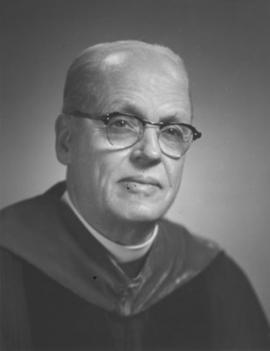
J. Ray Houser (1897-1981) was a Lutheran pastor, and President of Waterloo Lutheran Seminary in Waterloo, Ontario. Houser was educated at Gettysburg College and Mt. Airy Theological Seminary, Philadelphia. After his ordination in 1924 he served as a pastor in the United States. In 1954 he became President of Waterloo Lutheran Seminary, serving until his retirement in 1968.
AC00345
·
Person
·
1899 - 1975
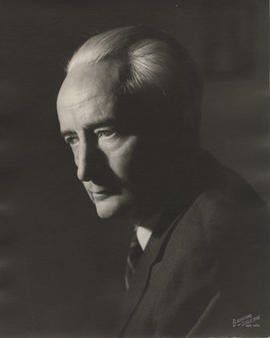
Gotthard Booth (1899-1975) was a medical doctor specializing in the practice of psychiatry concerned with chronic physical diseases, psychosomatic medicine, and studies in the relationship between religion and health. Born in Nuremberg, Germany, Booth graduated from the University of Munich Medical School in 1923, and in the early 1930s moved to the United States. He resided in Westport, Connecticut but maintained a practice in New York City. Booth taught at Columbia University from 1945 to 1953, was instructor for one year at the New York Medical College, and from 1962 was consulting psychiatrist for the Union Theological Seminary, New York. In 1965 he became a visiting lecturer at Waterloo Lutheran University (now Wilfrid Laurier University) and its federated college, Waterloo Lutheran Seminary. A fellow of the American Psychiatric Association, Booth's research resulted in the publication of more than 60 articles. He worked as a research associate with the New York Psychiatric Institute for ten years. He was also a member of the American Psychosomatic Society, the Academy of Psychosomatic Medicine, the New York County Medical Society, and the American Medical Association.
AC00338
·
Person
·
1871 - 1964
AC00332
·
Person
·
1937 -
Kenneth Hewitt (1937- ) was a professor of geography and environmental studies at Wilfrid Laurier University in Waterloo, Ontario, from 1976 until his retirement in 2002. Hewitt earned his BA and MA at Cambridge University, and his PhD at London University. He is a founding member of the Cold Regions Research Centre. Hewitt has been the recipient of many research awards. Hewitt was proclaimed Wilfrid Laurier University Research Professor for 1988-1989, and received the Award for Scholarly Distinction in Geography from the Canadian Association of Geographers in 1991.
AC00328
·
Person
·
1874 - 1950
William Lyon Mackenzie King (1874-1950) was Canada’s Prime Minister for 22 years, holding office 1921-1926, 1926-1930, and 1935-1948. King was born in Berlin (later renamed Kitchener), Ontario. King received his BA, LLB, and MA at the University of Toronto. At Harvard University he received an MA and a PhD. King was leader of the Liberal Party from 1919-1948.
AC00328
·
Corporate body
OTWRC is a group of citizens' and agricultural groups who succeeded in cancelling the Ontario Waste Management Corporation's plans to build a hazardous waste plant in West Lincoln in the Niagara Peninsula. The group now comments on hazardous waste issues in Ontario and pushes for waste elimination.
AC00325
·
Person
·
19- -
Jim Heldmann is an alumnus of Wilfrid Laurier University having graduated with a BA in 1958 and an MA in 1990. As an undergraduate, Heldmann was a member of the editorial staff of the Cord as well as News Weekly where wrote the humor advice column “Miss Winks”. He was also a member of the Keystone editorial staff and the curling team.
AC00323
·
Corporate body
·
1911-1960
The Evangelical Lutheran Seminary of Canada began in 1911. In 1924 Waterloo College was established, providing courses in post-secondary education. In 1960 Waterloo Lutheran University was formed, consisting of Waterloo University College and Waterloo Lutheran Seminary. In 1973 the name of the University was changed to Wilfrid Laurier University, with Waterloo Lutheran Seminary as a federated college.
AC00215
·
Corporate body
·
1953 -
Chelmsford Valley District High School is a high school located in the community of Chelmsford, Ontario, part of Greater Sudbury. The school opened in 1953. Its name was later changed to the Chelmsford Valley District Composite School.
AC0009
·
Person
·
1897-1969
Alexander Oberlander Potter (1897-1969) was a professor at Waterloo College (now Wilfrid Laurier University) in Waterloo, Ontario. Potter received his BA and MA from Gettysburg College, Pennsylvania, and his PhD from Columbia University. From 1923-1924 Alex Potter was an instructor at Waterloo College School. In 1924 he became the first Dean and Executive Head of the Waterloo College. A long time member of Rotary International, he served as Assistant to the President of Rotary International, Paris, France from 1937-1938. For several years he attended sessions of the League of Nations as a special observer and in 1931 represented Rotary International at the public conference on disarmament in Paris, France. In recognition of his services he was awarded the Order of St. Sava by the Yugoslavian government in 1936. During World War II, Potter worked for the Department of National War Services. After the war he returned to Waterloo College as a history professor, retiring in 1954. In 1965 Alex Potter received an honorary degree from Waterloo Lutheran University.
AC00067
·
Corporate body
·
1924-1960
In 1910 the Canada Synod and Synod of Central Canada of the Lutheran Church entered into an agreement to establish a Lutheran Seminary. Though the location first proposed for the Seminary was Toronto, Waterloo was selected when its citizens offered a tract of land on the boundary of the town. The choice of location was affected, too, by the fact that the majority of Lutherans in Ontario lived in the vicinity of Waterloo and Berlin (Kitchener). In 1911 the Evangelical Lutheran Seminary of Canada opened its doors.
Facilities for pre-theological education were established in 1914 with courses leading to senior matriculation given in Waterloo College School.
In 1924 the Waterloo College of Arts, providing courses in post-secondary education in a four year program, was established. In 1925 the Faculty of Arts, under the name of Waterloo College, affiliated with the University of Western Ontario. Waterloo College soon began to offer Honours degree programs in the arts.
The affiliation with the University of Western Ontario ended in 1960 when the Seminary obtained a revised charter changing the name of the institution to Waterloo Lutheran University.
On November 1, 1973, Waterloo Lutheran University became Wilfrid Laurier University, one of Ontario's provincially assisted universities after Bill 178 was given Royal Assent by the Lieutenant Governor (and former Waterloo Lutheran University Chancellor) William Ross Macdonald.
In September 1999, Laurier opened a campus in Brantford, Ontario.
AC00045
·
Person
·
1923 - 2005
Len Gertler (1923-2005) was a planner, administrator, author, and university professor, whose areas of study included planning, and public policy. Gertler was born in Montreal, Quebec, and was educated at Queen's University, McGill University, and the University of Toronto. Throughout his career he held a wide variety of positions. Len Gertler served as Director of the Edmonton District Planning Commission, and also held the position of Deputy Commissioner of Planning for the City of Toronto. In 1966 he became a professor at the University of Waterloo, establishing a new program in Urban and Regional Planning. He was also involved in establishing the University of Waterloo's Faculty of Environmental Studies, and became the first Director of the School of Planning. Gertler was the coordinator and author of the Niagara Escarpment Study in 1968. His international work included assignments in Indonesia, Jamaica, India, Japan, and Uzbekistan. Gertler was a member and Vice-Chair of the Ontario Environmental Assessment Board, from 1990-2001. The Canadian Institute of Planners' Award for Planning Excellence in 2001 was named in honour of Len Gertler.
AC0003
·
Person
·
1911 - 1993
Clara Bernhardt (1911-1993) was a poet, novelist, composer, and columnist, who lived in Cambridge, Ontario. At the age of eleven she was stricken with polio and confined to a wheelchair. Although she was unable to pursue more that a Grade 8 education, Bernhardt wrote poetry, articles, and stories. Her newspaper columns circulated in Canada and the United States for more than sixty years, and she was a columnist for the Preston Times Herald (now the Cambridge Times) for thirty years. She published three volumes of poetry, two novels, and a book of songs. In 1991 Clara Bernhardt was presented with the Order of Ontario.
AC0001
·
Person
·
1841 - 1919
Wilfrid Laurier (1841-1919) was Canada's eighth Prime Minister, holding office 1896-1911. Laurier was born in St. Lin, Quebec. He received a law degree from McGill University in 1864, and practiced law in Montreal and Arthabaskville from 1864-1896. Wilfrid Laurier was Liberal party leader from 1887 until his death in 1919.
092
·
Corporate body
·
1955 -
The Great Lakes Fishery Commission was established in 1955 by the Canadian/U.S. Convention on Great Lakes Fisheries. The commission coordinates fisheries research, controls the sea lamprey, and facilitates cooperative fishery management among the state, provincial, tribal, and federal management agencies.
075
·
Corporate body
·
1911-
Waterloo Lutheran Seminary (WLS) officially opened on October 30, 1911 in Waterloo, Ontario in a house located on five acres of land donated by the City of Waterloo. The first class consisted of four students and one full-time faculty member, Ottomar Lincke. Lincke would also serve as the first executive officer until 1914. In 1924, Waterloo College was established, providing courses in post-secondary education. The following year, the Seminary and Waterloo College affiliated with the University of Western Ontario (UWO) allowing students to earn an accredited degree. Women were allowed to attend to Waterloo College beginning in 1929.
In 1960 Waterloo College ended its affiliation with the University of Western Ontario and became an independent, degree granting institution called Waterloo Lutheran University that operated alongside the Seminary.
The current Seminary building was dedicated on October 20th, 1963. In 1973 Waterloo Lutheran University became a provincially-funded, secular institution and was renamed Wilfrid Laurier University. The Lutheran Church was no longer responsible for the operating the University but the Waterloo Lutheran Seminary remained a federated college of Wilfrid Laurier University.
In the 1980s, the Waterloo Lutheran Seminary gained full accreditation status in the Association of Theological Schools in the United States and Canada. In 1994, a Doctor of Ministry degree was added. The year 2010 saw the creation of the Kanata Centre for Worship and Global Song, which seeks to bridge the cultural gap between developed and less developed countries. Currently, the Seminary offers a variety of diploma, master’s and doctoral programs, as well as a Bachelor of Arts in Christian Studies and Global Citizenship.
056
·
Corporate body
·
1986-1999
In 1986, Uniroyal Chemical Company was formed as a subsidiary of Avery Inc. Then, in 1989, Uniroyal Chemical Company Investors Holding bought Uniroyal Chemical Company from Avery and became Uniroyal Chemical Corporation. In 1996, Uniroyal Chemical Corporation went public and merged with Crompton & Knowles. In 1996, Uniroyal Chemical Corporation went public and merged with Crompton & Knowles. In 1999, Crompton & Knowles merged with Witco to form Crompton Corporation. In 2005, Crompton acquired Great Lakes Chemical Company, Inc., of West Lafayette, Indiana, to form Chemtura Corporation.
044
·
Person
·
1929 -
Alan Querney was born November 3, 1929 in Toronto, to parents Ernest & Marjorie Querney. After growing up in Sudbury, Querney graduated from the University of Western Ontario in 1954 with an Honors degree in Business Administration. In 1957, he became a Chartered Accountant and in November of that same year, Querney began working in the lumber industry at WB Plaunt & Son Limited/Austin Lumber (Dalton) Limited. Querney married Shirley Richmond in London, Ontario in 1954. They had four children, Tom (b. 1958), John (b. 1960), Susan (b. 1964), and William [Bill] (b. 1967). In 1972, Bill Muirhead, a family friend, sold his family's business (Muirhead Stationers Limited) to Querney. After Alan Querney's sons graduated university, they became co-owners of the business as well.
Alan Querney was very active in the community. Querney was a member of the Laurentian University Board (Chairman, 1987-1990), the Board of Regents at Huntington College (Chairman), the Sudbury and District Chamber of Commerce, the Sudbury and District Chartered Accountants Association, the Sudbury Algoma Sanitarium (Secretary-Treasurer), the Sudbury and District Hospital Council (Chairman), Idylwylde Golf and Country Club (President), the Ontario Lumber Manufacturer's Association, St. Andrew's United Church Council and Finance Committee, and a member of the Board and Treasurer of St. Andrew's Place Inc. Querney received numerous awards in the community including becoming an Honourary Fellow of Huntington University (1977), receiving an Honourary degree of Doctor of Sacred Letters from Huntington University (1982), elected a Fellow of the Institute of Chartered Accountants of Ontario (FCA, 1985), awarded the Commemorative Medal for the 125th Anniversary of the Confederation of Canada (circa 1992), receiving an Honourary Degree of Doctor of Business Administration from Laurentian University (1996), received the President's Award from the Sudbury and District Chamber of Commerce (along with his sons, 1998), and elected a Life Member of the Institute of Chartered Accountants of Ontario (1999). He was also recognized as a Paul Harris Fellow by the Rotary Club of Sudbury in 2000 for charitable contributions. Alan Querney retired around 2002 and Tom Querney became President of Muirheads.
044
·
Person
·
1897-1972
Harley Anson Misener (1897-1972) was a genealogist in Ontario, researching the Misener family. Harley Misener was the seventh generation of Miseners whose first ancestors, Richard Misener and his wife Elizabeth, emigrated with their family from the Palatinate district of Germany to North America in 1720 and settled in New Jersey.
036
·
Corporate body
·
1949 - 1960
The Chelmsford Women's Institute was founded on June 3rd, 1949. It was created by the women of Chelmsford as a branch of the pre-existing Women's Institutes in Canada, founded by Adelaide Hoodless in 1897. Mrs. Grace McCrystal (nee Vaillancourt) organized the first meeting at her home in Chelmsford and sixteen ladies attended to listen to District President, Mrs. H. Williams, and District Secretary, Mrs. J. Hamilton, explain the work and aims of the Women's Institute.
The organization was founded as a non-partisan and non-sectarian group with the primary goal of education. Standing committees included Agriculture and Canadian Industries, Citizenship and Education, Community Activities and Public Relations, Historic Research and Current Events, Home Economics and Health, and Resolutions.
The Women's Institute helped local families in need, usually by raising funds, donating clothing or sending flowers. They also gave monetary donations to national causes, such as the Red Cross, presented papers at meetings on the topics of agriculture, local history, geography, shopping and hygiene and hosted events for members, such as baby showers, Christmas gift exchanges and sleigh rides. The group also took it upon themselves to document the history of Chelmsford with the creation of their Tweedsmuir History Scrapbooks between 1949 and 1956. The research for these scrapbooks was undertaken by their Historic Research and Current Events Standing Committee Convener, Rose Cvitkovich.
The Chelmsford Women's Institute officially disbanded in 1960.
Former Presidents of the Chelmsford Women's Institute include:
Mrs. A. Rheaume (1949 - 1950)
Mrs. Albert DeFinney (December 1950 - April 1951)
Mrs. Yvonne Trottier (nee Paquette) (1951 - 1952, 1953 - 1955)
Mrs. G. Castonguay (1952)
Mrs. R. Cvitkovich (1956)
035
·
Corporate body
·
2006 - 2017
Chemtura Corporation was a global corporation headquartered in Philadelphia, Pennsylvania, with its other principal executive office in Middlebury, Connecticut. The company focused on specialty chemicals for various industrial sectors, and these were transportation (including automotive), energy, agriculture, and electronics. Chemtura operated manufacturing plants in 11 countries, including Canada.
Chemtura Corporation was the successor to Crompton & Knowles Corporation, which was incorporated in Massachusetts in 1900 and engaged in the manufacture and sale of specialty chemicals beginning in 1954. Crompton & Knowles traces its roots to Crompton Loom Works incorporated in the 1840s. In 2005, Crompton acquired Great Lakes Chemical Company, Inc., of West Lafayette, Indiana, to form Chemtura Corporation. Additionally, Great Lakes Chemical Corporation still existed as a subsidiary company of Chemtura. On April 21, 2017, Chemtura was officially acquired by Lanxess for $2.1 billion in cash.
In Canada, Chemtura and its predecessor corporations operated a plant in Elmira, Ontario. Since 1941 the plant has undergone various name and ownership changes. From 1966-2000 the plant operated as Uniroyal Chemical, from 2000-2006 as Crompton Company, and on July 1, 2006 formally changed its name to Chemtura Canada Company.
035
·
Person
·
1880 - 1970
Charles Bibby was born in Manchester, England on September 15, 1880. The son of a Confectioner, Bibby was the oldest male of four children. After studying accounting and becoming a public accountant, Bibby immigrated to Canada with his wife Mary Swain (1881-1967) in March 1903. The couple settled in North Bay where Bibby worked as a clerk, and later as an accountant for the Canadian Pacific Railway (CPR).
The Bibby family suffered several tragedies while in North Bay with the deaths of three daughters (Isabella Bibby June 1902 [Lancashire, England] - January 10, 1904 [North Bay, cause: bronchitis for 2 weeks], Georgina May Bibby September 14, 1904 - August 28, 1905, [cause: diarrhea for 3 weeks], and Beatrice Bibby October 1, 1905 - September 3, 1906 [cause: diarrhea for 5 weeks]). On October 19, 1910, the couple had their last and only surviving child Charles Fredrick Bibby (who later became Warden Bibby with the Ministry of Natural Resources). Shortly afterwards (before June 1911), the Bibby family moved to Sudbury due to a transfer with the CPR.
While in Sudbury, Charles Bibby continued to work for the CPR and later gained employment as an accountant for the Sudbury-Copper Cliff Street Railway until his retirement in 1945. He also belonged to the Nickel Lodge 427 of Ancient Free and Accepted Masons (he was initiated in Sudbury in 1918, became a Worshipful Master in 1924 and a Grand Steward in 1959) as well as the Tuscan Chapter 95 Royal Arch Masons, Mavar Preceptory 65, the Sudbury Shrine Club, and Rameses Shriners Temple in Toronto.
In 1928, Charles Bibby was elected mayor of the Town of Sudbury and was re-elected in 1929, the year before the town became a city.
Charles Bibby passed away on August 7, 1970 at the age of 89.
034
·
Person
·
1903-1987
Eva Wolotko was born in November 1903 to parents Anton Wolotko and Mary Fox Wolotko in Chapleau, Ontario. Wolotko had one brother, Joseph Wolotko (October 1910 - December 12, 1949, AKA Joe Wolotko), who played hockey for teams in Chapleau and Falconbridge, Ontario in the Nickel Belt League. In 1938 Eva Wolotko moved to Sudbury, Ontario and in 1940 she married Earle Cram (aka Erle C. Cram, Ernie Cram, 1907-1964), a firefighter and former lumber and construction worker. The marriage ceremony occurred in Wolotko's hometown of Chapleau but the couple lived in Sudbury. Eva Wolotko Cram had a career as a dressmaker and later as a school crossing guard. She belonged to St. Andrew the Apostle Roman Catholic Church and died on September 26, 1987 at the age of 83.
032
·
Corporate body
·
1929-1961
The Canadian Bank of Commerce was first established on May 15, 1867 in Toronto, Ontario. Through amalgamations with regional banks, it grew to include branches across the country. With additional acquisitions in the 1920's, the bank became one of the strongest branch networks in Canada with well over 700 locations by 1929.
In 1936 the Canadian Bank of Commerce was the first bank in Canada to establish a personal loans department. At first, the bank would only issue loans, for a maximum of $1,000, in the Toronto and Hamilton areas. After the success of this pilot project, loans were extended to Canadians across the country.
During the second world war, the Canadian Bank of Commerce, along with other banks across Canada, assisted the government with the implementation of Victory Loans and War Ration coupons. The Victory Loan campaigns raised around $12 billion for the war effort, with almost three million Canadians buying war loan bonds. With the war ration coupons, banks became responsible for the accounting of food ration coupons in March, 1943 and gasoline ration coupons in April, 1944. The federal government first introduced ration coupons in April, 1942 for gasoline (until Aug 1945) and for certain food products in June, 1942 as a way of insuring equitable distribution of these supplies because of an acute shortage during the war. (Sugar - June 1942-1947, tea - 1942-Sept 1944, coffee - 1942-Sept 1944, butter - Dec 1942 -June 1947, meat - May 1943-March 1947, preserves - Dec 1943-1947, and in some areas evaporated milk - Dec 1943-1947.) After the initial year, the government decided banks in Canada were in a better position to handle the accounting aspect of the ration coupons and the banks agreed, provided they were able to limit the amount of paperwork involved. Dealers such as jobbers and brokers, wholesalers, creamery and cheese factories, importers of tea and coffee, retailers whose normal monthly gross sales in food exceeded $5,000, as well as businesses which served meals including the rationed goods, such as hotels, restaurants, and hospitals, were required to conduct ration bank accounts. With the ration bank accounts, these dealers and food server businesses would deposit and withdraw ration stamps in the same manner as financial accounts. Each ration product required a separate account for these businesses. When ration supplies were needed, a business would simply write a cheque in the amount of the ration stamps required from their specific product ration account. In turn, when customers purchased a rationed product, they would hand the business the required number of stamps and they would then deposit them into the specific ration accounts for their next purchase from their suppliers (both the businesses and the public were still required to pay cash for their rationed products along with the ration stamps.)
After the war, the Canadian Bank of Commerce increased their holdings to include branches in newly created suburbs and in 1954, along with the rest of the banks in Canada, began to offer mortgages for newly constructed homes. Prior to this time, all banks were barred from the mortgage business since 1871, leaving life insurance companies to offer the majority of mortgages to the public.
On June 1st 1961, the Canadian Imperial Bank of Commerce was formed through the merger of The Canadian Bank of Commerce and the Imperial Bank of Canada. The merger occurred due to both banks growth in the resource industry. The Imperial Bank of Canada was unable to keep up with the increasing needs of its resource industry clients and in an attempt to meet these needs and to ward off a possible buyout by a foreign bank, a new, larger bank was formed by the merger.
The Sudbury Branch of the Bank of Commerce first opened on June 22, 1929. Located on the corner of Elm and Elgin in the former Sterling Bank of Canada building, this bank became the eighth to locate to Sudbury (The Sterling Bank of Canada 1905-1924, opened January 30, 1909 in Sudbury. This bank merged with the Standard Bank of Canada in 1924 and the Standard Bank of Canada merged with the Canadian Bank of Commerce in 1928). The Town of Sudbury Building Permits record a H.R. Sheldon for Sterling Bank applying for a building permit on July 1, 1918 for 151 Elm Street. The building material included 80,000 bricks, 1,100 yards plastering, 1,000 cubic feet stone work, and 2,900 cubic feet concrete. This branch served as the main office in Sudbury until a larger branch was opened at the corner of Cedar and Lisgar Streets. As the Canadian Imperial Bank of Commerce, the Elm and Elgin branch merged with the Cedar Street branch on October 24, 1997, leaving the Elm and Elgin Street location vacant.
031
·
Corporate body
·
1914
O'Flynn Cash Grocery opened in January of 1914 in Copper Cliff, Ontario. It is not known if the store had an actual physical location on Poplar Street, if it occupied a section of McKinnon's General Store, or if it was a catalogue store with a mailing address of Poplar Street. The ordering procedures mentioned in the store's price list, however, suggest that it was a catalogue store.
Miss Rose O'Flynn was the proprietor of the 'cash only' store, which was a novelty in Copper Cliff due to the exclusive use of credit in that area. The experimental store had a short life, closing sometime before the start of 1915, though the exact date is unknown.
Rose O'Flynn was born Mary Rosetta Flynn (sometimes written as O'Flynn) on April 5, 1890 in Ensley Township, Newaygo, Michigan to James Joseph Flynn and Mary Ellen Flynn (née Mary Ellen Wolfe). Her parents were born and married in Ontario, but immigrated to the United States of America in 1881 or 1882. Rose O'Flynn lived with her family in Michigan until 1907, at which time she went to live in Copper Cliff with her mother's sister, Hester McKinnon (née Hester Ann Wolfe) and her family. Hester McKinnon was married to John Romantions McKinnon who owned and operated a department store, J.R. McKinnon & Sons. Rose O'Flynn worked as a saleslady there and lived with the McKinnon's until her marriage to Gregory Lee on June 8, 1915. Her wedding day was a simple affair, with the only guests being close friends and relatives of the bride and groom. Rose O'Flynn's cousin, Richard McKinnon, walked her down the aisle. After a honeymoon in Cornwall, Ontario; Boston, Massachusetts, and New York, New York the couple returned home to Copper Cliff.
Rose O'Flynn Lee was a homemaker and took care of the couple's four children, three girls and a boy. She was also deeply involved with her church, St. Stanislaus Roman Catholic Church, and was a member of the Catholic Women's League and the Altar Society. Rose O'Flynn Lee died June 3, 1950 at the age of 60 in her home in Copper Cliff.
030
·
Corporate body
·
January 1944 - June 1980
St. John the Evangelist Roman Catholic Church was built in Garson, Ontario in 1913-1914. Prior to this time, mass was celebrated in Garson by a visiting priest from Ste. Anne's Parish in Sudbury with the first mass in Garson celebrated in 1906 by Reverend G.S. Lebel. In 1935 the mission of St. John's, which included the towns of Garson and Falconbridge, became a parish and Reverend John P. Coghlan was named the first Parish Priest, serving until 1964. In March of 1950 the original St. John's church succumbed to fire and another church was immediately built in its place, with the first mass being held there on December 17, 1950.
The Catholic Youth Organization (C.Y.O.), affiliated with St. John's, was established in January 1944 due to the efforts of Father A.J. Sullivan. The C.Y.O.'s first meeting had twenty people in attendance and by 1946 had grown to include approximately fifty members, who were divided into 'junior' and 'senior' groups. It was a popular unit within the church and many events and programs were held for the benefit of the members. Events included dances, debates, quiz nights, holiday parties, roller skating parties and tobogganing outings. The C.Y.O. also took great interest in athletics and took part in a bowling league and a baseball league, as well as organized hikes, skiing trips and dart tournaments for members. By April 1946 the C.Y.O. was running its own news bulletin, which was used to relay gossip, local news and events within St. John's Parish and to advertise upcoming parties and events being held by the C.Y.O. The C.Y.O. remained in existence until June 1980.
The editorial staff for the years 1946-1947 were:
Editor: Lil Scagnetti
Assistant Editor: Mike Dudowich
Typist: Diane Scagnetti [Di Scagnetti/Diane Dellelce]
Printer: Abele Crisante
Sports Editor: George Morin
Poetry Department: Marg Lachapelle
Senior Reporter: Theresa Moreau, Claire Daoust
Junior Reporter: Rose Devuono, Bea Laliberte
Deliveries: Stan Hyduk
Social Editor [April 1946]: T. Egan
029
·
Corporate body
·
1949 - 1976
The Soroptimist Club was formed in Oakland, California in 1921 for women who hold executive status in business, government or a profession. Membership was by invitation only and was limited to women with careers outside of the home. The aim of the Soroptimist Club was to provide service to the community, usually through fundraising and donations, to promote the advancement of women in business and to maintain high ethical standards in professional life.
The Soroptimist Club of the Sudbury Nickel District was chartered on January 29, 1949. It was founded by Margaret Kerr of Montreal. Elizabeth Soutar (Bess Soutar), head of the local Victorian Order of Nurses (V.O.N.), was the first President of the Sudbury Nickel District chapter. The club met twice monthly, on the second and fourth Mondays, the first only for business and the second to have a dinner meeting followed by business and/or a speaker. These early meetings were held mainly at Cassio's Motor Hotel or in members' homes.
During it's life, the Soroptimist Club sponsored many community projects, including providing a monthly allowance for three years to a nurse in training; Christmas dinners to elderly members of the community; sponsoring the Soutar Senior Citizen's Club; sending underprivileged children to summer camp; giving a clothing allowance to a secondary school student, which allowed her to graduate; providing rent for underprivileged college students during the summer months; donating $500 to the Centennial Project for trees in Bell Park; giving a donation of $1000 so a room could be refurnished at the Y.W.C.A. and putting on concerts.
The club celebrated their 25th Anniversary with dinner at Cassio's Motor Hotel in the Venetian Room on June 8, 1974. However, membership and participation in the club was declining. By 1975 meetings dwindled and only seven or eight women were taking an active interest, so in 1976 the club's activities came to an end after 27 years.
Club Presidents:
Bess Soutor 1949-1950
Kay Elliott 1950-1950
Allegra Walker 1951-1952
Eleanor Hambley 1952-1954
Lempi Johnson 1954-1955
Grace Wigg 1955-1957
Thelma Paulson 1957-1959
Ursala Black 1959-1961
Margaret Blue 1961-1962
Mary Brown 1962-1964
Florence Tomlinson 1964-1966
Myrtle Kennedy 1966-1969
Editha McLellan 1969-1970
Mary Brown 1970-1972
Myrtle Kennedy 1972-1974
027
·
Corporate body
·
1948 - After 1962
Robert Baden-Powell's book, Scouting for Boys, was first published in England in 1908. Shortly after, Scouts began forming all over Canada. In 1910, a Dominion Council was established and Governor General Earl Grey accepted the position of Chief Scout for Canada. The Boy Scouts Association was incorporated in the United Kingdom two years later. In June 1914, a Canadian branch of that organization - The Canadian General Council of the Boy Scouts Association - was incorporated. In 1920, the International Conference, to which all recognized Boy Scout associations belonged, was formed.
The first meeting of the 1st Coniston Wolf Cub Pack, which was part of the Coniston Boy Scout Association was in October 1948. This 1st troop was affiliated with the All Saints Anglican Church and, in late 1948, a 2nd troop was formed which was affiliated with the Catholic Church (the French speaking boys attended Our Lady of Mercy Church while the English speaking boys attended St. Paul's Church). Both troops existed at the same time in Coniston and frequently participated in events and fundraising together. The 1st Coniston Wolf Cub Pack held their troop meetings on Tuesday nights, but they would have events, such as tobogganing parties and parades, on other days of the week. Regular activities of the troop included camping, hiking, first aid training, hockey, watching National Film Board movies, and father & son banquets. The troop was funded through various fundraising activities, such as candy sales on Valentine's Day.
In September 1956, the 1st Coniston Troop approached the 2nd Troop with the proposition of forming one group for Coniston. Bishop Dignan gave permission for boys from the 1st Troop to join, provided the 2nd Troop had control of the troop. During 1956 and 1957, the 2nd troop had difficulties recruiting Cub Masters who had the time to volunteer and the group folded by 1958 with the remainder of their bank balance being donated to the 1st Coniston Group Committee on November 12, 1962.
Presidents (Chairmen) listed in the scrapbook were:
Roy Snitch (1948 - 1949)
J. Rogerson (1952 - 1953)
021
·
Family
·
1902 - present (in Canada)
Robert Thomas Stevens [Roberto Tomaso Stefanizzi] was born in Cellara, Cosenza, Calabria, Italy on February 23, 1896 to Gaetano Stefanizzi and Gaetana Caliguiri. At the age of 6, he immigrated to Canada with his uncle Francesco Steffanzzi (aka Frank Stevens d. 1941 age 70) in 1902 while the rest of his family remained in Italy.
As a teenager during the first world war, Stevens operated a commissary at Nobel for the explosives plant employees. Stevens enjoyed being an entrepreneur and in 1918, he decided to venture into the film industry by opening his first theatre in Sudbury on Elm Street East. His theatre business thrived and over the years, Stevens expanded his business with the acquisition of additional theatres in Sturgeon Falls, Creighton Mine and Sault Ste. Marie. For a few years, Stevens also owned a theatre in Espanola. In August 1939, Stevens opened the large Regent Theatre on Elm Street in Sudbury. This theatre was well known for its size in Northeastern Ontario.
On December 4, 1923, Robert Stevens married Florence Boucher, a nurse originally from Whitefish, Ontario. The ceremony was held in Little Current, Ontario. They had six children; Joseph 'Robert' Guy (1924-1968), 'William' Alfred (1926-1988), 'Thomas' Joseph (1928-), Anne Marie (1930-2004, married name Ripley), John (1931?-), and Margaret Theressa (1934-).
During the second world war, Robert Stevens, along with many other Italian-born Canadians, was closely monitored by authorities. On August 24, 1940, Stevens was a patient at St. Joseph’s Hospital, suffering from a slight ailment. At 10 a.m. he was arrested on charges, under the Defence of Canada Regulations, for during August 14 to 20, 1940 “making statements intended to, or likely to, prejudice recruiting, training, discipline and administration of His Majesty’s forces,” and “making statements intended to, or likely to, cause disaffection to His Majesty.” He was escorted from his hospital room to the Royal Canadian Mounted Police headquarters for questioning. Afterwards, he was taken to the courthouse. Stevens was denied bail by the Magistrate and placed in a prison cell at the Sudbury District Jail until his trial three days later. Stevens plead guilty to the first charge and was fined $25. The second charge was dropped.
Robert Thomas Stevens became ill in January 1943 and passed away at St. Joseph's Hospital in Sudbury on February 13, 1943 at the age of 46.
019
·
Person
·
1945 - present
Jim Dufour was born in Thunder Bay, Ontario in 1945. He moved to Sudbury for work at INCO in 1964 at the Copper Cliff Iron Ore Plant. After a year in Copper Cliff, Dufour was moved to Stobie Mine where he worked for the next 34 years. At Stobie, Dufour performed a variety of tasks over the years including working underground. For the last 15 years of his career, Dufour was responsible for scheduling and training miners at Stobie. He co-ordinated the instuctors for training new employees on the history of mining, terminology, current practices, and safety. After 35 years at INCO, Jim Dufour retired in 1999.
018
·
Family
·
1937-present (in Sudbury, Ontario)
The Querney family first came to Sudbury, Ontario in 1937 from Toronto, Ontario due to Ernest T. Querney's new position as Manager of the Northern Electric Company Limited. Ernest & Marjorie Querney's son Alan Querney was born November 3, 1929 in Toronto.
In 1972, Bill Muirhead, a family friend, sold his family's business (Muirhead Stationers Limited) to Alan Querney. After Alan Querney's sons graduated university, they became co-owners of the business as well. Tom Querney (trained in economics, Chartered Accountant) became the general manager, Bill Querney (McMaster, Commerce Degree) the furniture warehouse manager, and John Querney (Laurentian, Commerce Degree) the sales manager of the office furniture section. Alan Querney retired around 2002 and Tom Querney became President of Muirheads.
In May 2005, the Querney family sold Muirheads to Grand & Toy, an OfficeMax company. They became the largest commercial office products company in Northern Ontario.
In 2009, John and Bill Querney decided to leave Grand & Toy and start their own office supply business. Querney's Office Plus opened to the public at 67 Elm Street (right beside the former location of Muirheads), Sudbury, Ontario on July 19, 2010 with the grand opening celebration on October 21, 2010.
016-.1
·
Person
·
1924 - 2000
Eeva Annikki Kantokoski was born May 8, 1924 in Alajärvi, Finland to Matias (Matti) Niilo Kantokoski (born 1901), and his wife Anna Milia (born 1903). The family name was shortened from Kantokoski to Koski, but it is unclear when exactly this occurred. Eeva Annikki and her parents immigrated to Canada in 1924. They arrived in Halifax, Nova Scotia on August 2, 1924, and then settled in Sudbury, Ontario. In December 1925, Eeva Annikki’s brother, Veikko Vesa Matias Kantokoski (Koski) was born. Sometime after their arrival in Canada Eeva Annikki's name was changed to Ann Eva, though others often referred to her as Anne, Anni or Annie. The family's early years were spent in Sudbury, Ontario. After the death of their mother in 1933, Ann and her brother Veikko lived with their father in Sudbury during the summer months and their aunt Ida Marie (Koivula) Lehti in Oshawa during the winter. Ann completed her education in Sudbury, Ontario in 1939, and gained a High School Entrance Certificate, though she did not attend due to the cost. Once she completed her schooling in 1939 she found employment in domestic service for Mrs. J. Ferrier, in Sudbury. Between 1940 and 1941 she worked at Korpela's Grocery Store on Bancroft Drive, and Maki's Restaurant on Elgin Street in Sudbury, Ontario. In 1942, Ann moved to Malartic, Quebec to work in a bunkhouse and kitchen in a mining town. There she met Archie Chisholm, whom she married in Montreal on May 24, 1942. Their first child, Carl Richard, was born on December 24, 1943. When her husband was posted overseas during World War II, Ann returned to Sudbury to stay with relatives, and completed a Red Cross Volunteer Nursing Service course during that time. After the Second World War, Ann and Archie had two more children; Leslie Karen, born March 8, 1947, and Barry Neil, born October 8, 1955. While living in North-western Quebec, Ann contributed her time to the Protestant Elementary School Board and the Canadian Air Force Ground Observer Corps. In 1974, she separated from her husband and moved to Dartmouth, Nova Scotia. There she completed high school and went on to study nursing. She became a Certified Nursing Assistant, and obtained a post-graduate diploma in psychiatric nursing. Between 1976 and 1986 she worked at the Nova Scotia Hospital. Ann Eva Chisholm died on March 12, 2000 at the age of 74, and is buried in Dartmouth, Nova Scotia.
016
·
Family
·
1924 - present (in Canada)
The Kantokoski (Koski), Koivula, and Korpela families originated from Finland, but many members immigrated to Sudbury and other parts of Canada and the United States. These families inter-married over the years and have many shared descendants who settled in Sudbury.
015-.2
·
Person
·
1941 - present
Diana Joyce Heit was born January 3, 1941 in Sudbury, Ontario. The eldest of Jacob and Katherine Heit's five children, Diana was raised in Garson, Ontario. She attended St. John's Separate School in Garson and often went to Falcona Camp, run by Falconbridge Mine in the summer. Diana Heit married Lawrence Thomas Mulcahey on September 5, 1964 at St. John's Church in Garson. She later became the Assistant Programme Director for the Recreation Department of the City of Sudbury. With this position, Mulcahey assisted with the creation of the game ringette. She designed the crests for the local team tournaments and organized the first games.
015-.1
·
Person
·
1914-1999
Jacob 'Jack' Sebastian Heit was born on February 5, 1914 in Tramping Lake, Saskatchewan. He moved to Sudbury, Ontario, travelling by train at a cost of $6, and arrived on March 25, 1938. Heit took many odd jobs such as seasonal mail deliverer during the Christmas season in 1939 or work for Pioneer Construction in 1940. Other odd jobs included 'pick and shovel' work, farm work, house construction, cement drilling, and steel jobs. He worked for firms such as Red Brown Cement Products, Gustiana Company, and A.L. McGinn using his skills as a mechanic and blacksmith. He began his career at Falconbridge Nickel Mines Ltd in 1941 underground as a miner. He later became an Inspector for Mine Safety and First Aid. Heit was certified in basic Mine Rescue Training at the Sudbury Rescue Station in June 1948. By 1951, he received the Advanced Mine Rescue Training and in 1961 the Supervisory Advanced Mine Rescue Training. In May 1950, Heit was a member of the winning team of the inaugural First Aid Championship of Falconbridge Nickel Mines at a competition held in the Community Hall. Heit continued to compete in both local and Northern Ontario mine rescue competitions and won several times. Awards included the H.J. Fraser Trophy for defeating the top plant first aid team at Falconbridge.
Heit was also an avid volunteer with the Garson Volunteer Fire Department for 20 years (circa 1950 to February 1971). When Heit resigned from the fire department, he held the position of 'deputy fire chief.' He was also an amateur photographer and won 1st prize for the best photograph of the King and Queen's visit to Sudbury in 1939.
Jack Heit married Katherine 'Kay' Kraft (born March 4, 1918 in Allan, Saskatchewan) on February 5, 1940 at Christ the King Church in Sudbury, Ontario. They had five daughters, Diana (1941), Janet (1943), Marilyn (1947), Kathy (1948), and Susan (1954).
Heit retired from Falconbridge Ltd in 1976. He remained active in the community with bridge games, curling, and water skiing. For their 50th wedding anniversary, Jack and Kay Heit renewed their vows at the same church they were originally married.
Jack Heit passed away on November 5, 1999 at the age of 85 at Extendicare York in Sudbury, Ontario.
015
·
Family
·
1939 - present (in Sudbury, ON)
The Heit family first moved to the Garson, Ontario area shortly after Jacob "Jack" Heit (1914-1999) married Katherine "Kay" Kraft (1918-2009) on February 5, 1940 at Christ the King Church in Sudbury, Ontario. Prior to this time, both Jacob Heit and Katherine Kraft lived in Saskatchewan. The Heit's raised their family of five daughters, Diana, Janet, Marilyn, Kathy, and Susan in Garson, Ontario.
012
·
Corporate body
·
1914 -
The scouting movement was founded in England in 1907 by Robert Baden-Powell, then a lieutenant-general in the British army. Scouting came to Canada in early 1908 with three troops established almost simultaneously in Merrickville and St Catharines ON and Port Morien, NS, and in 1912 the Boy Scout Association was granted a royal charter throughout the Commonwealth by King George V. The Canadian General Council of the Boy Scout Association, incorporated 12 June 1914, was a branch of the Boy Scout Association until 30 October 1946 when it became an independent member of the Boy Scout World Conference. The name was changed to Boy Scouts of Canada and to Scouts Canada in 1976.
012
·
Person
·
1927 - 1998
Michael Dudowich was born January 31st, 1927 in Garson, Ontario. As a young student, Dudowich began working on the weekends for Mr. W.E. Mason at the Sudbury Star in 1943. In high school, Dudowich was the Director of Photography for the Sudbury High yearbook the Wolfhound as well as Assistant Editor for the Catholic Youth Organization Bulletins affiliated with St. John the Evangelist Roman Catholic Church. In the 1946 Sudbury High yearbook, grade twelve student Dudowich stated his future goal for later in life was to photograph actress Lana Turner.
In 1947, the Dudowich family moved from Garson to Riverside Drive, Sudbury, Ontario. After graduating with honours from Sudbury High School, Dudowich worked for a short time as a locomotive fireman and then proceeded to work full time for the newspaper. Eventually, he became the photographic supervisor for the Sudbury Star and held the position of 'Chief Photographer' for decades prior to his retirement in May, 1976.
Dudowich was an active member of the Commercial and Press Photographers' Association of Canada (CPPAC) for many years. He frequently attended the short course in photography held annually at the University of Western Ontario by the group and won multiple awards for his photographs including the CPPAC Award of Merit and several of the Canadian Press Picture-of-the-Month awards. He was chosen Best Photographer of Canada, and his work appeared in the publication "America." In 1972, Dudowich received awards from the Canadian Government and the Canadian Press for his work in the Russian/Canadian Hockey Series of that year.
Dudowich was a charter member of the Idylwylde Golf and Country Club, a member of the Ukrainian Congress of Canada, the Laurentian Museum and Arts Centre and St. Mary's Ukrainian Catholic Church.
Michael Dudowich passed away on May 4th, 1998 at the age of 71.
011
·
Corporate body
·
1948-1958
Robert Baden-Powell's book, Scouting for Boys, was first published in England in 1908. Shortly after, Scouts began forming all over Canada. In 1910, a Dominion Council was established and Governor General Earl Grey accepted the position of Chief Scout for Canada. The Boy Scouts Association was incorporated in the United Kingdom two years later. In June 1914, a Canadian branch of that organization - The Canadian General Council of the Boy Scouts Association - was incorporated. In 1920, the International Conference, to which all recognized Boy Scout associations belonged, was formed.
The first recorded date for the Our Lady of Mercy Boy Scout Association in Coniston, Ontario was 1948. The first entry in their Minute Book begins with the last meeting of the year in 1948 so there most likely was another Minute Book created before this, possibly for years prior to this date, and lost. Prior to their formation, there was already a Coniston Boy Scout Association. The first troop was affiliated with the Anglican Church and this, the second troop, was formed to be affiliated with the Catholic Church (the french speaking boys attended Our Lady of Mercy Church while the english speaking boys attended St. Paul's Church). Both troops existed at the same time in Coniston during the entire life of the Our Lady of Mercy Boy Scout Association and frequently participated in events and fundraising together. The Our Lady of Mercy Boy Scout Association Board held their meetings in the basement of the Separate School in Coniston every month. Troop meetings tended to take place on Tuesday nights at 7pm but they would have events on other days. Activities of the troop included camping, hiking, first aid training, hockey, watching National Film Board movies, and father son banquets. They were funded with Apple Day sales, Christmas Card sales, and various other fundraising activities.
During the summer of 1953, the Our Lady of Mercy Boy Scout Association won the 'All Over' trophy at summer camp, signifying that they were the best cub pack from the Sudbury District attending the camp. In 1955, three Scouters resigned; one to attend school out of town and the other two, who were the Cub Masters Mr. & Mrs. Gobbo [Art Gobbo & Evelyn Gobbo]. In September 1956, the 1st Coniston Troop approached the 2nd Troop with the proposition of forming one group for Coniston. Bishop Dignan gave permission for boys from the 1st Troop to join, provided the 2nd Troop had control of the troop. During 1956 and 1957, the troop had difficulties recruiting Cub Masters who had the time to volunteer and the group folded by 1958 with the remainder of their bank balance being donated to the 1st Coniston Group Committee on November 12, 1962.
Presidents (Chairmen)
Edward J. Orendorff 1948 - 1952, May 1953 -after 1957 (also principal of Coniston Continuation School)
O. Paradis 1952 - 1953
G. Maher January - May 1953
Chaplains for Troop
Father Fortin 1948 - 1951
Father Lafontaine 1953
Father Proulx 1956 - 195?

011
·
Corporate body
·
1900 - 1929
The Mond Nickel Company Limited was a United Kingdom-based mining company, formed on September 20, 1900, licensed in Canada to carry on business in the province of Ontario, from October 16, 1900. The firm was founded by Ludwig Mond (1839-1909) to process Canadian ore from mines near Sudbury, which were then shipped to Mond's works in Britain for final purification.
The first of Mond's Canadian mining properties located in Denison Township, was purchased from Ricardo McConnell and associates in 1899. this site renamed the Victoria Mine began development in 1900. About the same time, Mond's refinery at Clydach, near Swansea, Wales, was being erected.
Around the same time, Mond purchased from McConnell, second mining location the Garson Mine which was developed later on, in Garson Township.
In 1911 the Mond company began construction of a new smelter at Coniston, Ontario. In that year, the company purchased the mining rights at Frood Extension about 8 miles from Coniston, though no serious development took place at this location until the 1920s. By 1928 INCO began development of its Frood Mine, when it was determined that it and Mond's Frood Extension were part of the same ore body, Alfred Mond negotiated an agreement pursuant to which in 1929 the interests of the Mond Nickel Company were merged into the International Nickel Company through the issue of the latter's stock in exchange for the outstanding stock of Mond.
010
·
Person
Jean Narozamski was a horticulturist and a librarian who helped to found the Walden Garden club in 1976.
009
·
Corporate body
·
1976 - 198-
The Walden Garden Club was first founded by Jean Narozanski in 1976. Narozanski was the municipal horticulturalist in Walden and also worked at the public library. She noticed a desire of residents to learn more about horticulture and founded the club to provide an outlet for various homeowners to discuss gardening. That same year, Narozanski also established Northern Perennials, a local gardening store. By 1980, Narozanski moved to Manitolan Island and the club discontinued around the mid 1980's.
Former Chairmen of the Walden Garden Club include;
Jean Narozanski 1976-1977
Evelyn Nelson 1977-1978
Myra Gauthier 1978-1979
008
·
Person
·
1919 - 2008
Denis Landry was born in Azilda, Ontario, on May 16, 1919. He began his academic pursuits at the age of seven and matriculated from Azilda Public School #2 at fourteen with an eighth grade education. Landry was unable to continue formal academic pursuits due to economic reasons and began to work on the family farm where he pasteurized milk and took care of the animals. Landry married his wife Thérèse Paquette on January 6th, 1945 and they had seven children. In order to support his family Landry worked as a miner for Inco at the Levack Nickel Mine Deposit where he held many positions. Despite his work, Landry still found the time for his family, and his community.
Landry was a devote catholic and enjoyed religious music. Denis was a member of the “paroisse de Chelmsford” choir and when the “paroisse Sainte-Agnès” was formed in 1953, he became leader of orchestra and remained so for 20 years.
Landry was an important figure for the education sector in the Azilda - Chelmsford area. He played a significant role during the creation of the Roman Catholic Separate School Section No.1 in 1955. Landry was appointed trustee for the RCS.S No.1 from 1955 to 1956. Thanks to Landry and other trustees, the Roman Catholic schools in the No.1 and No.2 district merged in 1961 and two new Separate schools were created “l’école St-Patrick” and “l’école St-Dominique-Savio”. In 1965 Landry was appointed to serve as trustee for the Chelmsford Valley District High School Board to represent all the Separate Schools in the areas of Rayside Balfour, Chelmsford, Dowling, and Levack. He spent six years as a trustee with the Chelmsford Valley District High School Board, to ensure that Catholic children from the area have an opportunity to pursue their studies at the secondary level. In 1968, the Ministry of Education warned the school boards of its intention to establish larger administrative units. Landry was appointed by the Chelmsford High School Board to serve in the “ADD-Hoc” committee in order to prepare the documents needed to restructure the School Boards in Ontario. Denis was then elected to represent the Western Separate Schools in 1969. He was honored to serve as a representative for the Western Separate Schools for the following 12 years. Denis Landry’s 32 years of service as a trustee for Separate Schools, gave generations of French Catholic children in the Azilda, Rayside area the opportunity to learn and grow in a proper education system.
Landry retired from Inco after 43 years of service. After his retirement he went on to work as a Real Estate agent. He was a strong supporter of the French culture in the community. His passion for education, the town of Azilda and the French culture inspired him to write a book entitled “Azilda comme je l’ai connue”.
Landry was also a member of the “Coopérative funéraire” and the “Club d’âge d’or d’ Azilda” (one of the founding members). For the remainder of his retirement Landry continued to devote himself to his pastimes, his community and his family. Denis Landry passed away on May 6th 2008 at the age of 88.
007
·
Person
·
1919 - 2011
Israel "Irving" Steinberg was born January 16 1919 in Peterborough Ontario. Shortly after his birth he moved with his parents, Joseph and Leah Steinberg and his sister Rose Steinberg, to Sudbury Ontario where his father founded Toronto Bargain Stores. The Steinbergs lived in Sudbury until 1932 when they moved to Toronto. Joseph Steinberg died on July 14 1963, and Irving Steinberg as executor of his estate retained property in Sudbury until 1968 when it was expropriated by the city as part of a downtown urban development project. Irving Steinberg passed away on March 1, 2011.
006
·
Person
·
1931 - Present
Robert John Keir was born in Port Colborne, Ontario, on April 15th, 1931. While Keir's British grandfather was a professional journalist, Keir himself never recieved formal training in journalism; instead, he developed and honed his journalistic skills through years of on-the-job experience. Keir began his journalism career at an early age as a paperboy for the Globe & Mail. As an adult, Keir began writing for The Evening Tribute of Welland, Ontario, from 1950-1952. It was also during this time that Keir was given the opportunity to work as a “stringer”, writing additional local stories for large media outlets The Toronto Star and the Buffalo Courier-Express. In 1954, Keir became an out-island feature writer for The Nassau Guardian of Nassau, Bahamas, under a six-month contract. When his contract expired that same year, Keir relocated to Sudbury, Ontario. Once in Sudbury, Keir continued to pursue his journalistic interests, covering local affairs for The Sudbury Star from 1954 until 1956. From 1956 to 1957, Keir reported City Hall proceedings for CKSO Radio and Television and from 1957 to 1959, reported these proceedings for The Sudbury Star.
In 1955, Keir was appointed Northern Ontario Correspondent for The Globe and Mail and retained this freelance position for more than ten years. In 1959, Keir founded the Northern Information Service Company Limited in Sudbury, Ontario. As General Manager, Keir played a participatory role in handling freelance news coverage, public relations, advertising, and photography until he ended the company in 1970. In addition, Keir was one of the founders of The Sudbury Sun in 1962, serving as publisher and editor.
By the early 1960’s, Bob Keir had become an active supporter of local interests. This resulted in a shift in career interests, which saw Keir serve as Public Relations consultant for the City of Sudbury from 1960-1961. Keir served one term as Alderman (1964-1965), and despite not continuing as an elected member of city council, Keir stayed on as a volunteer, serving on various community committees (such as the Sudbury Planning Board and the Parking Authority of Sudbury). Keir moved to Toronto in 1970 to work as Senior Communications Manager for the Ministries of Environment, Natural Resources, and Energy at Queen’s Park, but returned to Sudbury in 1982 to serve as Executive and Communications Officer for Regional Chairman Tom Davies until Keir’s retirement in 1995.
After retiring, Keir continued to publicly voice his concerns over local issues. As one of seven members of the Greater Sudbury Municipal Watch since discussion of Sudbury’s amalgamation began in the late 1990’s, Keir monitors key issues at City Hall. Other local initiatives Keir has been involved in include the Sudbury Community Foundation (as a founding director) and the Sudbury Regional Restructuring Association (as a founder and secretary). In 1992, Keir was awarded the Canada 125 Commemorative Medal for his volunteer efforts and the Ontario 15 Years Voluntarism Award. Additionally, Keir provides regular published insights in letters to the editor for The Sudbury Star.
004
·
Person
·
1917 - 2007
0037
·
Person
·
1909 - 1970
Ulrich S. Leupold (1909-1970) was a professor and Dean at Waterloo Lutheran Seminary in Waterloo, Ontario. He obtained his PhD in musicology from the University of Berlin in 1932. He was ordained by the Canada Synod in 1939 and served as a pastor until 1945. He was appointed Principal in 1969. He authored, arranged, and composed numerous works. Wilfrid Laurier University's Leupold Residence is named in his honour.
00357
·
Person
·
1962 -
Theresa McClenaghan (1962-) is a Canadian lawyer. She has pursued public interest environmental law throughout her career, representing individuals, groups, and First Nations in environmental matters of local, regional, and national significance. McClenaghan obtained her LLB from the University of Western Ontario, an LLM from Osgood Hall Law School, York University, and a diploma in Environmental Health from McMaster University. She has been called to the bar of Manitoba and Ontario, and has practiced law in Kitchener, Paris, and Toronto, Ontario.
003
·
Person
·
1953 -
Michael Kelly was born in Sudbury Ontario in 1953 and attended Laurentian University from 1973 to 1978. He graduated with a Bachelor of Arts in History and then matriculated to the University of Toronto (1979-1985) for his Master of Arts in History. During this time, he was asked to write a chapter in an upcoming local Sudbury history book to help celebrate the one hundred anniversary of the founding of Sudbury. The book was divided up into decades and Michael Kelly was assigned 1900-1910. This chapter was later completed by Ashley Thompson and the book was published ten years after its intended publication date in 1993 entitled Sudbury Rail Town to Regional Capital.
Other books Kelly worked on while a student at Laurentian include Inventory and Guide to Historic Building in Sudbury, 1978.
From 1979 to 1985, Kelly traded commercial paper and foreign exchange securities as part of a corporate cash management team with INCO Limited. From 1985 to 1986 he was a regional economic development officer in Northern Ontario and from 1986-1989 he operated as a training consultant for various companies. From 1990 to the present, Kelly has worked as a professor at Cambrian College specializing in Human Relations, Ethics and Project Management.
0027
·
Person
·
1932 -
James Gordon Nelson, (1932- ) was a professor at the University of Waterloo, in Waterloo, Ontario until his retirement in 1998. Nelson received his BA from McMaster University, his MA from Colorado, and his PhD from Johns Hopkins University. Before accepting a position with the University of Waterloo in 1975, Nelson held academic and administrative positions at the University of Calgary and the University of Western Ontario. He is an ecologist, a geographer, a planner, and a policy maker. James Gordon Nelson has been a member of the College of Fellows of the Royal Canadian Geographic Society, a committee member of the World Commission on Protected Areas of the International Union for Conservation of Nature and Natural Resources, a member of the National Executive Committee of the Canadian Parks and Wilderness, and Ontario's Representative on the National Board of Governors of Heritage Canada. He has received many awards, including the first Natural Heritage Award in 1978, the Canadian Association of Geographers Award for Scholarly Distinction in Geography in 1983, the Massey Medal for the Royal Canadian Geographic Society in 1983, a Certificate of Achievement from the Grand River Conservation Authority in 1994, and the 1994 Environment Award for the Regional Municipality of Waterloo.
0001
·
Corporate body
·
1973-
In 1910 the Canada Synod and Synod of Central Canada of the Lutheran Church entered into an agreement to establish a Lutheran Seminary. Though the location first proposed for the Seminary was Toronto, Waterloo was selected when its citizens offered a tract of land on the boundary of the town. The choice of location was further influenced by the fact that the majority of Lutherans in Ontario lived in the vicinity of Waterloo and Berlin (Kitchener). In 1911 the Evangelical Lutheran Seminary of Canada opened its doors.
Facilities for pre-theological education were established in 1914 with courses leading to senior matriculation given in Waterloo College School.
In 1924 the Waterloo College of Arts, providing courses in post-secondary education in a four year program, was established. In 1925 the Faculty of Arts, under the name of Waterloo College, affiliated with the University of Western Ontario. Waterloo College soon began to offer honours degree programs in the arts.
The affiliation with the University of Western Ontario ended in 1960 when the Seminary obtained a revised charter changing the name of the institution to Waterloo Lutheran University.
On November 1, 1973, Waterloo Lutheran University became Wilfrid Laurier University, one of Ontario's provincially assisted universities after Bill 178 was given Royal Assent by the Lieutenant Governor (and former Waterloo Lutheran University Chancellor) William Ross Macdonald.
In September 1999, Laurier opened a campus in Brantford, Ontario.
Corporate body
·
1927-1990
Canada Packers, Inc. (now Maple Leaf Foods, Inc.) was a Toronto-based meat packing and processing company.
The company was formed out of a succession of mergers with predecessor companies. These include the William Davies Company, Ltd. (est. 1854), the Canadian Packing Company, Ltd. (est. 1868 as the George Matthews Company), Gunns Ltd. (est. 1876), and the Harris Abattoir Company, Ltd. (est. 1896). These firms merged in 1927 to form Canada Packers, Ltd., which became Canada Packers Inc. in 1980. In 1990 Canada Packers Inc. merged with British based Maple Leaf Mills, Ltd. to form Maple Leaf Foods, Inc.
History of Accumulator
History of Accumulator
Barry Test was an example authority record made to test AtoM and Archivematica metadata links.
Barry was born in Burnley, Lancashire and grew up in Hebdon bridge. Barry was a good little lad.
Person
Earle Clare Shelley (1905-1990) was a graduate of Waterloo College (now Wilfrid Laurier University) in Waterloo, Ontario, and a professor, high school teacher, poet, and author. Born in Bridgeport, Ontario, Shelley attended high school at Waterloo College School from 1920-1924. He received his BA from Waterloo College in 1928, and was head of the French Department at Waterloo College from 1928-1931. Shelley graduated from the College of Education at the University of Toronto in 1932 and taught high school for 33 years. He served with the Canadian Army from 1939-1946. He wrote several books of poetry, and also compiled a two-volume French grammar dictionary. Shelley served on the Alumni boards of Waterloo College, Waterloo Lutheran University, and Wilfrid Laurier University, and also on the Senate and Board of Governors of the University. In recognition of this service, the Alumni Association named Earle Shelley "Alumnus of the Century".
Example Creator History (this will be added to the related authority record's History field, ISAAR 5.2.2)
Barry Test was an example authority record made to test AtoM and Archivematica metadata links.
Barry was born in Burnley, Lancashire and grew up in Hebdon bridge.
Person