
Dr. Allon Peebles was born October 20th, 1900 in New Westminster. He graduated from UBC in 1920 and had a Ph.D. in economics from Columbia. Dr. Peebles taught economics at the University of California and at Columbia had worked with a committee in the United States on the costs of medical care. A medical and labour research economist, he was chairman of B.C.’s first Health Insurance Commission in 1936 and helped fashion the later B.C. Hospital Insurance Service. The 1936 Health Insurance Act was written by Peebles and Harry Morris Cassidy. In 1941, Peebles went to Ottawa as first executive director of the Unemployment Commission and was in charge of the labour department’s research and statistics. He wrote several books on medical facilities, insurance and care. After retiring from the labour department in 1947, Allon Peebles entered private business in Chatham, Ontario. He died in Ottawa on March 13, 1962.
Personal Studio was founded by Robert T.G. Nicol and a friend, and officially opened for business on March 21, 1946. Nicol was the sole photographer and owner by the fall of 1946. For the next fifty years Robert Nicol documented the Waterloo Region through personal and commercial photography. He pioneered the concept of wedding albums in the local area. He had started flying in 1961 and from that time on took aerial photographs as well as studio and candid photography. In the course of his career he maintained memberships in professional photographers' organizations as well as completing continuing photographic educational courses offered by those organizations. He retired as a professional photographer in 1996.
Pioneer Construction was founded in Sudbury by Joe Salvalagio, Pietro Coltinari, and Mario Negusanti in 1938. The team hired Alex Macgregor as manager shortly after.
By the 1950s Pioneer Construction was tackling city and highway road construction, sewer and watermain projects, while expanding into the mining, forestry and railroad industries. In 1954, Pioneer Construction was home to the first asphalt plant in the North. Company ownership transferred to Grant Henderson, Peter Crossgrove and then to Jamie Wallace in 1976. Today Pioneer Construction builds and maintains highways and municipal roads across Northern Ontario.
Alexander Oberlander Potter (1897-1969) was a professor at Waterloo College (now Wilfrid Laurier University) in Waterloo, Ontario. Potter received his BA and MA from Gettysburg College, Pennsylvania, and his PhD from Columbia University. From 1923-1924 Alex Potter was an instructor at Waterloo College School. In 1924 he became the first Dean and Executive Head of the Waterloo College. A long time member of Rotary International, he served as Assistant to the President of Rotary International, Paris, France from 1937-1938. For several years he attended sessions of the League of Nations as a special observer and in 1931 represented Rotary International at the public conference on disarmament in Paris, France. In recognition of his services he was awarded the Order of St. Sava by the Yugoslavian government in 1936. During World War II, Potter worked for the Department of National War Services. After the war he returned to Waterloo College as a history professor, retiring in 1954. In 1965 Alex Potter received an honorary degree from Waterloo Lutheran University.
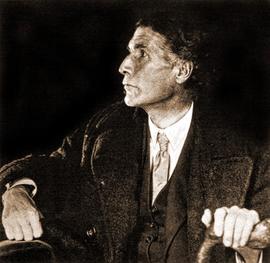
John Cowper Powys (1872-1963) was an English author and lecturer. Born in Derbyshire, England, he was the eldest of eleven children of Rev. Francis and Mary Powys. John Cowper Powys was educated at Sherborne School and Corpus Christi, Cambridge. He first lectured at girls' schools in the Brighton area, and from 1898 to 1909 lectured for the Oxford University Extension Delegacy. In 1905 he made his first lecture tour in the United States, where he continued to tour until 1934. Powys' publications include novels, an autobiography, and a series of philosophical essays. In 1958 he received the plaque of the Hamburg Free Academy of Arts for outstanding services to literature and philosophy. In 1962 Powys received an honorary degree from the University of Wales.
The Querney family first came to Sudbury, Ontario in 1937 from Toronto, Ontario due to Ernest T. Querney's new position as Manager of the Northern Electric Company Limited. Ernest & Marjorie Querney's son Alan Querney was born November 3, 1929 in Toronto.
In 1972, Bill Muirhead, a family friend, sold his family's business (Muirhead Stationers Limited) to Alan Querney. After Alan Querney's sons graduated university, they became co-owners of the business as well. Tom Querney (trained in economics, Chartered Accountant) became the general manager, Bill Querney (McMaster, Commerce Degree) the furniture warehouse manager, and John Querney (Laurentian, Commerce Degree) the sales manager of the office furniture section. Alan Querney retired around 2002 and Tom Querney became President of Muirheads.
In May 2005, the Querney family sold Muirheads to Grand & Toy, an OfficeMax company. They became the largest commercial office products company in Northern Ontario.
In 2009, John and Bill Querney decided to leave Grand & Toy and start their own office supply business. Querney's Office Plus opened to the public at 67 Elm Street (right beside the former location of Muirheads), Sudbury, Ontario on July 19, 2010 with the grand opening celebration on October 21, 2010.
Alan Querney was born November 3, 1929 in Toronto, to parents Ernest & Marjorie Querney. After growing up in Sudbury, Querney graduated from the University of Western Ontario in 1954 with an Honors degree in Business Administration. In 1957, he became a Chartered Accountant and in November of that same year, Querney began working in the lumber industry at WB Plaunt & Son Limited/Austin Lumber (Dalton) Limited. Querney married Shirley Richmond in London, Ontario in 1954. They had four children, Tom (b. 1958), John (b. 1960), Susan (b. 1964), and William [Bill] (b. 1967). In 1972, Bill Muirhead, a family friend, sold his family's business (Muirhead Stationers Limited) to Querney. After Alan Querney's sons graduated university, they became co-owners of the business as well.
Alan Querney was very active in the community. Querney was a member of the Laurentian University Board (Chairman, 1987-1990), the Board of Regents at Huntington College (Chairman), the Sudbury and District Chamber of Commerce, the Sudbury and District Chartered Accountants Association, the Sudbury Algoma Sanitarium (Secretary-Treasurer), the Sudbury and District Hospital Council (Chairman), Idylwylde Golf and Country Club (President), the Ontario Lumber Manufacturer's Association, St. Andrew's United Church Council and Finance Committee, and a member of the Board and Treasurer of St. Andrew's Place Inc. Querney received numerous awards in the community including becoming an Honourary Fellow of Huntington University (1977), receiving an Honourary degree of Doctor of Sacred Letters from Huntington University (1982), elected a Fellow of the Institute of Chartered Accountants of Ontario (FCA, 1985), awarded the Commemorative Medal for the 125th Anniversary of the Confederation of Canada (circa 1992), receiving an Honourary Degree of Doctor of Business Administration from Laurentian University (1996), received the President's Award from the Sudbury and District Chamber of Commerce (along with his sons, 1998), and elected a Life Member of the Institute of Chartered Accountants of Ontario (1999). He was also recognized as a Paul Harris Fellow by the Rotary Club of Sudbury in 2000 for charitable contributions. Alan Querney retired around 2002 and Tom Querney became President of Muirheads.
Henry A. Regier (1930 - ) was a professor of zoology and environmental studies at the University of Toronto until his retirement in 1995. Regier received his BA from Queen's University, a professional teaching certificate from the University of Toronto, and his PhD from Cornell University. In 1966 he joined the University of Toronto. Henry Regier's research interests include the Great Lakes, human use of aquatic systems, world population, and climate change. Regier served as a Canadian commissioner on the Great Lakes Fishery Commission, from 1980 to 1989. From 1987 to 1990 he served on the Great Lakes Science Advisory Board of the International Joint Commission of Canada and the USA. Regier has received many awards, including the Conservation Award of the Federation of Ontario Naturalists in 1980, the Centenary Medal by the Royal Society of Canada in 1986, the Award of Excellence of the American Fisheries Society in 1992, and the Lifetime Achievement Award from the International Association of Great Lakes Research in 2005.
George Agnew Reid (1860-1947) was a Canadian artist, architect, educator and administrator influential in the early 20th century and instrumental in the formation of a number of important Canadian art institutions. Born in Wingham Ontario to a Scottish farm family, he studied architecture and book-keeping at his father’s insistence. In 1878 he moved to Toronto to study art. He was able to extend his art education under Thomas Eakins in Philadelphia, where he met the painter Mary Heister. In 1888 the couple travelled to Europe and studied at the Julian and Colorossi Academies, returning to Toronto in 1889. The house he designed and built in Wychwood Park was his home until the end of his life. In 1890, George Reid began reaching at the Central Ontario School of Art and Design. He eventually became principal and researched new theories of art education in the United States and Europe. Under his direction, the art school became independent of the Board of Education and moved into its own building, which he designed, in 1921. He also served as its first Principal. In 1892, George and Mary Reid built two cottages from his design at the artist colony in Onteora, New York. This led to the design of other summer homes and a small church in the Catskills community. They spent summers at this location until 1917 when the war made travel to the United States difficult. In 1921 Mary Heister Reid died, and in 1923 George Reid married Mary Wrinch, a former student and close friend of his first wife. His later life was filled with accomplishments, including the painting of murals for public spaces in Toronto City Hall, Jarvis Collegiate, the Royal Ontario Museum and elsewhere. He was instrumental in obtaining permanent funding and staff for the National Gallery in Ottawa, and was a force behind the establishment of the Art Gallery of Toronto. He was a member of the RCA, serving as President 1906-1907. He influenced a generation of students, among them C.W. Jefferys, through his teaching and created a number of works that exemplify his generation, including Forbidden Fruit, Mortgaging the Homestead, and The Foreclosure of the Mortgage.
Judith Rodger is a freelance curator and art historian based in London, Ontario. Rodger was chief curator of the London Regional Art & Historical Museum, and was personally acquainted with Greg Curnoe. She contributed the chronology and bibliography to the catalogue of the exhibition Greg Curnoe: Life and Stuff (Toronto: Art Gallery of Ontario, 2000). For a biographical sketch of Greg Curnoe, please see Greg Curnoe fonds.