- ON00120 019
- Fonds
- ca. 1916
This fonds consists of one VHS copy of a Mond Nickel film, originally recorded on 16mm film.
Dufour, Jim
150 results with digital objects Show results with digital objects
This fonds consists of one VHS copy of a Mond Nickel film, originally recorded on 16mm film.
Dufour, Jim
Part of Jim Dufour
Part of Jim Dufour
Typed Transcript - Azilda, centre rural progressif
Part of Chelmsford Women's Institute
Azilda, centre rural progressif
Part of Chelmsford Women's Institute
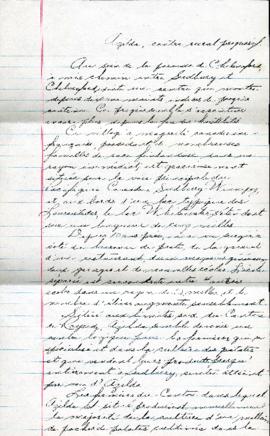
Item is a four page, handwritten paper regarding Azilda, Ontario. This paper includes the history of Azilda, its geography and landscape, the French-Canadian and Finnish families who made up the majority of the inhabitants and the town's agricultural economy.
Part of Laurier Brantford fonds
File consists of family photographs taken in Canada.
Series consists of photographs of various members of the Kantokoski/Koski family, the Maki family, Laura Siltanen, Saima (Saimi) Susanna Pellikka, Lempi Maria Buerala, Archie Chisholm, Leslie Karen Chisholm, Carl Richard Chisholm, and the residence of Mr. James Ferrier.
Ann Eva Chisholm (nee Kantokoski/Koski)
Sous-fonds consists of photographs and various textual material.
Chisholm, Ann Eva (nee Kantokoski/Koski)
One annotated print copy of a black and white photograph of Matti Nikolai Kantokoski and his wife Maria Sofia sitting in a horse-drawn cart, while a young boy stands beside them holding a bicycle.
This fonds consists of membership and executive board lists, newsletters, newspaper clippings, and various other textual records concerning gardening information.
Walden Garden Club
The fonds consists of photographs and negatives depicting scenes of Waterloo College (later named Waterloo Lutheran University and Wilfrid Laurier University) and portraits of faculty, staff, and students.
Personal Studio (Waterloo, Ont.)
The fonds consists of copy prints of photographs taken by Chooutla (Carcross) Residential School teacher A. Richard King of his students and their school life in and around Carcross, Yukon. Subjects include Mr. King, Principal Lawson, Vice-Principal Walters, supervisors Miss Fennell, Miss Barstow and Beverly Bear, the school, tobogganing, and games and activities during Winter Carnival Days and Sports Day. Also included are images of the Matthew Watson General Store and tourists waiting to board the White Pass and Yukon Route (WP&YR) train at the Carcross station. Many of the students in the photographs are identified including Helen Malcolm, Dorothy Johnnie, Judy Hager, Vivian Smith, Velma Silas, Ben Johnson, Nancy Tizya, Virginia Simon and Ann Smith.
King, A. Richard, 1919-2005
The fonds consists of personal papers and correspondence, household receipts, farming accounts and correspondence, and solicitations for business, building contracts, building accounts, business receipts and correspondence, banking papers, income tax papers, legal papers, assessment rolls and tax notices for the Township of Nelson and the Municipality of Burlington, wartime papers, education papers, Federal government papers, voters’ lists, Fruit Growers Association Reports, Ontario Department of Agriculture bulletins and other booklets about growing fruit collected by Blair. There is also considerable material pertaining to Knox Presbyterian Church including annual reports, financial statements and account books, quit claims, mortgage, deeds etc., lists of subscribers to the building fund, membership list, and magazines. Items with very early dates were acquired by George Blair in course of his professional life. The records were not consistently organized and were received by the Archives after the family had sorted them. Fonds is comprised of the following series: Account books 1861-1915. - 11.5 cm. Banking papers 1878-1928. - .5 cm. Business records 1878-1928. - 20 cm. Federal government papers 1887-1919 (artificial series). - .5 cm. Household receipts 1879-1928. - 1.5 cm. Income tax papers 1918-1924. - 1 cm. Insurance policy papers 1893-1927. - 1 cm. Investment papers 1889-1927. - .5 cm. Knox Presbyterian Church 1844-1930 (artificial series). – 1.5 cm. Legal papers 1850-1923. - .3 cm. Municipal records 1861-1928. - 12 cm. Personal papers 1860-1928. - 3 cm. War papers 1914-1918 (artificial series). - 2 cm.
Blair, George, 1852-1935
The fonds consists of publications, papers, manuscripts, correspondence, newspaper clippings, rough notes, case files, and other materials created and accumulated by Gotthard Booth.
Booth, Gotthard, 1899-1975
This fonds consists of one DVD copy of a VHS copy of a film, originally on 16mm.
Stevens Family
Emily Stowe and Augusta Stowe Gullen collection
The collection consists of photographs; scrapbooks of correspondence, photographs, and newspaper clippings; monographs; poetry and prose; biographical information; and other material complied by and about Emily Stowe and Augusta Stowe Gullen. Material relates to their personal and professional lives, and the suffrage movement.
Stowe, Emily Howard, 1831-1903.
The Mining and Smelting of Canadian Nickel
Part of Jim Dufour
One silent film of Mond Nickel mines in the Sudbury area. Film is divided up into the following sections by title cards (time each card appears in the film is noted before each title card caption);
Part I
00:00 – The Mining and Smelting of Canadian Nickel, Mond Nickel Company, Coniston, Ontario, Canada
00:08– Nature’s Storehouse and the Company Mines
01:24– Diamond drilling to determine location and extent of ore body
02:01– A Typical Nickel Mine
02:12– Let us go down into the mine and see how Nickel Ore is obtained
02:57– We will follow the car through passages called “Drifts” far below the surface
04:14–The end of the drift. Drill runners preparing a blast to extend the drift to reach new work
05:24– With compressed air force and great noise the sharp edges cut into the ore while a stream of water pours through the hole to keep the drill cool
06:23- Dynamite handle with care
06:31– Fuses eight feet long burn four minutes. Detonating cap being placed on end of fuse
06:41– The cap is inserted in the charge of dynamite
07:02– Ten or twelve holes are made from four to ten feet deep in a surface of five square yards
07:21– One stick of dynamite is placed in each hole for every foot of depth, about 30 lbs. in all, the last stick in each hole has a fuse attached
08:30– We didn’t wait to see what happened, but this was the result
09:15– When main development drift is finished the ore above on each side is measured into sections called stopes, 100 feet wide, 100 feet high and as deep as the ore runs, leaving a pillar of solid ore 40 feet thick between the stopes as a brace
09:43– Each stope is mined as a unit – Sub drifts run from main development drift under each stope. Draw holes are run up at 45 degrees from the drift to develop the stope and draw out the ore
09:57– Each stope has several draw holes from twenty-five to thirty-five feet apart – a draw hole viewed from the drift
10:22– Let us follow the miner into the stope
10:42– Here a stoping gallery is made 8 feet high and full size of stope. The roof or hanging wall at the high side is cut horizontally and broken down forming a perpendicular face which is carried, blast after blast, the full length of the stope
11:02– These blasts are fired by electricity
11:17– Section after section layers eight feet thick are blasted from the roof and broken up on the floor. Lumps too big to be broken up with hammers are broken with a small dynamite blast. Blasting large lumps
12:16– One third of ore is removed, two thirds are left on floor to stand on in reaching the hanging wall when blasting down the next layer
12:33– This operation is repeated to within ten feet of the floor of the next level above. When all the draw holes are closed, the miners enter and leave by “rises” from the drifts above
12:50– Miners going up out of a stope through a rise. These rises serve also as auxiliary shafts in case of fire or closing of mine shaft
13:22– When all the ore in the stope is blasted down and broken up, the drawholes underneath are opened and the ore removed
14:39-This – the cheapest and safest method of Copper Nickel mining is followed in 90% of Mond Nickel Co. operations – 100,000 tons of ore are stored in this way at one time
14:59– Diagram of overhand stope mining method
15:23– In the underhand method of mining, one draw hole is made at 45 degrees through the stope – then a working gallery is made at the top of the stope. The ore is mined and blasted downward through the draw hole and removed at once. Scene in an underhand stope
15:55– In ever widening series of ledges like a great funnel this ore is mined and removed
16:09– Men with scaling ladders constantly inspect the walls of partially emptied stopes to remove dangerous loose pieces of ore
16:59– The skip may be loaded direct from cars on main drift – cars hold two tons – two cars fill the skip
17:44– It is not always convenient to load skips at each level. Ore may be passed down through storage pockets to a suitable loading level far below
18:09– The grating over the passage to lower level is called a grizzly and is for protection of men. This ore goes direct to loading pocket, a great bin cut 50 feet deep in the rock
18:26– From the main drift above loading level, ore is passed from cars through grizzly to loading bin
18:50– The ore is measured into skip loads weighing four tons. The skip weighs three tons
19:36– A waste dump on each level where rock is loaded direct into skip
19:55– Drills dull very quickly and must be taken up to be sharpened
20:20– Ladders as well as the skip run to the lowest level
20:31– Telephones furnish communication between the drifts and the offices above
20:59– The end of the shift. All aboard for daylight
22:11– Safety switch on operator’s bridge stops all motion instantly in case of accident or danger
22:33– Compensating balance of the two skips and cable
22:45– Skips carrying ore go direct to top of shaft house
23:20– On next floor below ore and rock is separated – both pass through crushers and are broken up
23:49– From crushers the waste rock goes direct to bins over railway cars. Ore goes through a revolving screen which sifts out the “fines”
24:13– On the picking belts, waste rock, low grade ore and high grade ore are separated
24:32– Waste rock, fines, low grade ore and high grade ore are being loaded into cars from bins
25:01– Let us inspect the equipment above ground before following the ore to the smelter
25:10– Power used throughout the mines, smelter and town sites is Hydro-Electric generated at the Company’s own development plants and transmitted over 72 miles of line. Wabagashik – the Company’s first power development
25:56– Seventy feet of head, developing 5,000 Horse Power
26:33– Two horizontal twin turbines develop 1250 H.P. each
Part II
00:00– Nairn Falls, four miles from Wabagashik, capable of developing 7,200 Horse Power
00:45– Two single runner vertical turbines develop 2,400 H.P. each
01:12– The power lines – 44,000 volts leaving power house
01:42– At mines, power is transformed to 500 and 110 volts for service – Transformer station at mines
02:03– Three compressors supply 7,700 cubic feet of air per minute to pumps, air cranes, forges, skip brakes and 80 miner’s drills
02:44– Sharpening ore drills. Clearing water passage and retempering
03:35– The repair shops at the mine
03:48– The dynamite house is far removed from other buildings, only 24 hours supply kept on hand
04:09– Dynamite freezes at 40 degrees and must be thawed out
04:22– The store house and mine offices. A “shift” is checking in
04:32– A well equipped emergency hospital for first aid
04:47– The dry house. Hot air below – ventilation above – Clothes are dry when needed again
05:31– Homeward bound – clean and happy
05:49– At Levack mine connections with main line C.P.R. four miles distant is made over the Mond Nickel Co’s own right of way and equipment
06:10– “Old Reliable” the Mond Mine at Victoria, 3,000 feet deep – the deepest mine in Canada
06:52– Worthington Mine
07:06– Garson Mine has ten levels and is the greatest producer
08:01– Bruce Mine supplies 50 tons of quartz daily for smelting purposes, and pays its way by the Copper produced
08:22– The ore from all the mines is brought to Coniston, Ont. for smelting
09:21– All material is brought into smelter and moved from process to process in car load lots over standard gauge in Railway or the Company’s own cars by the Company’s own motive power. Ore train arriving from the Mines
10:01– All material entering smelter is weighed and taken to storage bins at smelter or to storage yard. High grade ore on the scales
10:39– Unloading high grade green ore at the storage yard
11:15– The Storage Yard
11:53– From the scales the green ore may be taken direct to smelter storage bins
12:16– Ore having as low as 15 to 20 pounds of Copper Nickel to the ton and formerly rejected, is now separated by a system of oil flotation. Low grade ore is first taken to the rock house and broken up
13:01– The flotation mill where low grade ore passes through a series of processes to secure the small amount of valuable metal
13:24– Here the ore is ground as fine as meal between rolls and screened
13:53– The oversize returns to the mill. The fine is mixed with water in a feeder
14:11– The concentrating tables make the first reparation of metal from dross. The concentration or valuable ore pass over and – the dross is watched over the ride.
14:37—The concentration pass to the settling tanks. The rejected ore is carried into a tube mill and ground very fine.
15:02—Very fine ore is carried to first floatation unit, oil, and sulphuric acid are added, and the mixture churned into froth.
15:20—The valuable ore is coated by the oil and floats to the surface into bubbles.
15:36—The remaining ore settles to the bottom and is drown into second unit where it is again churned up and the concentrates removed.
15:54—This process is followed through ten similar units. Finally, the middlings are returned to the head of the system—tailings go to dump.
16:18—Concentrates are sent to settling tank where ore gravitates to bottom—water overflows into receiving trough
16:42— these concentrates also fine green ore from the mines and valuable flue dust from the blast furnaces are fused together in sintering plant.
16:58—Cars of concentrates, fine ore and flue dust are emptied into bins at top of sintering plant.
17:24—Gates measure correct quantities onto endless belt carriers.
17:55—Seperated into two streams – one for each sintering machine
18:16—loading the sintering machine – coarse grain on bottom, fine on top
18:36—an oil blast is forced through the sinter to fire box below causing incipient fusion of all particles together and removing 15% of the sulphur
19:40— The fusion or sponge like formation binds the particles together yet allows free action of furnace blast increasing the furnace capacity for green ore
20:13— The sinter is taken to smelter storage bins
20:18—Loading high grade green ore, sinter, coke and limestone onto furnace charging cars at bottom of storage bins.
21:01—Charging one of the four great furnaces each unit with capacity of 750 tons daily, 4 ½ % metal value. This process is constant.
22:31—Lower section of blast furnaces and water jackets.
22:42: Air pressure pipes—exhausts stack—and passage way from storage bins to smelter.
23:01—22 tons of valuable ore dust is collected in these flue bins daily.
23:20—Flowing at a temperature of 900 to 1050 degrees molten medal is constantly pouring into settler.
23:43—The Settler. The limestone added in furnace charge has heated the iron and rock making it fluid, being lighter this dross rises to the surface in settler and constantly pours off in the form of slag.
24:22—Slag pots, each holding 40 tons being emptied on the slag dump.
25:47—Over 1000 tons of slag are added to this dump every day
26:13—Let us return to the settler. The ore enters the settler—4 ½ % nickel copper from the furnaces. The iron and rock flow off the top as slag.
26:30—The nickel, copper, and some iron gravitate to the bottom and are drawn off at intervals in great ladles. This furnace matte is 16% nickel copper.
27:07—Lifting fifteen tons of molten metal from settler to the magnesite brick lined converters.
27:46—To this molten mass is added silica quartz from Bruce Mine as a flux.
28:02— Adding oxygen under 12lbs, pressure, the iron is Bessemerized at a temperature of 950 to 1100 degrees
28:26—The iron slag is drawn off at intervals and returned to settler where any remaining nickel copper gravitates to bottom
28:50—As ore and quarts are added and slag drawn off, nickel copper deposit gradually rises in convertor to 45 or 50 ton weight when 80% copper nickel called 80% Bessemer Matte is drawn off and poured into moulds.
30:16—Cooling – Breaking – Crushing Matte
31:00 – Measuring –weighing – barreling matte for shipment
32:29—Ore enroute to seaboard
32:45— The smelter equipment. The Power-House, Company’s own Hydro-Electric throughout
33:14—Six Company locomotives are houses here
33:37—General view of Company’s well equipped repair shops
35:12—The store-house where $250,000 worth of stock is kept
35:21—The laboratory is finally equipped for metallurgic work
36:34—The Drafting Room
36:45—The General Offices
37:02—“All aboard for town”
37:27—“Coniston” from the hill-top—1200 population—half mile from smelter
38:14—Bessemer Matte 80% copper-nickel
Series consists of one annotated photocopy of a computer printout of the Koivula family tree, beginning with Henrik Jakobsson Koivula; a photocopy of a handwritten family tree concerning descendants of Susanna Sanna Johansdotter Saarela Koivula; an annotated photocopy of a computer printout of a continuation of the Koivula family tree; a photocopy of an annotated computer printout of a family tree of the Luoma-Aho family; a photocopy of a handwritten family tree beginning with Adolf Henriksson Koivula; one annotated colour computer printout of an image of the Koivula house in Alajärvi Finland and another colour computer printout of two more images of the Koivula house in Alajärvi, Finland (2008); six pages of photocopies of a handwritten family tree of the daughters of Amalia Koivula (born 1863) and their families; an annotated photocopy of an annotated, typed family tree of Hilma Koivula, which was compiled by her daughter Anja (Roiha) Kovala; a photocopy of an annotated, typed list of the children of Taimi Hakomaki Heino Bertrand; a photocopy of a typed list of the children of May (Roiha) & William Kauko Lahti; a photocopy of an annotated, typed list of the children of Enni Yli-Harsila and Henry Roiha; and a photocopy of an annotated, typed list of the children of Anja (Roiha) & Arne Kovala; one newspaper obituary for Oscar Maki from the Sudbury Star in 1939; one photocopy of an obituary [from the Sudbury Star in 1947] for Julia Koivula Maki Salo; and 9 photographs.
File consists of nine photographs of the Korpela family.
Irving Steinberg Sudbury Slide Collection
Colour slides depicting various sights in and around Sudbury in the late 1950s and early 1960s. Some of the slides are numbered suggesting they were part of a larger slideshow on Sudbury. Slides may have been collected to support claims related to the city expropriation of properties on Borgia Street in the 1960s. Slides were produced by various studios in Ontario.
Steinberg, Israel "Irving"
Part of Cooke fonds
Series consists of letters written by William J. Cooke and others in support of the Trillium Award for the Aldershot community.
Part of Cooke fonds
Series consists of visitor maps of Burlington; advertisements and manuals for appliances, furniture, and Mack trucks; Burlington Centennial promotional material; concrete industry-related magazines and articles; and invitations and greeting cards. Series includes a Hamilton Forum program, 1961; a history of St. Matthew’s Church, 1951; and a historic tour of Aldershot, 2002.
Part of Cooke fonds
Series consists of articles relating to W.J. Cooke and his involvement in the concrete industry; his work with the Rotary Club and other organizations; Cooke concrete plant history; development projects; Oaklands, Aldershot, and other local history; and the concrete industry.
Part of Cooke fonds
Series consists of images relating to the Cooke family and businesses. Subjects include J. Cooke Concrete history (possibly compiled for a book), Grimsby Brick & Tile Co., concrete plant demolition, the Townsend home, and Oaklands.
Arts and Letters Club of Burlington
The fonds consists of minute books, treasurers reports, membership lists, lists of speakers and programmes, listings of books circulated, scrapbooks and photographs. There is one wooden plaque, presented to “Arts & Letters Club” on the occasion of the Incorporation of the City of Burlington, January 1, 1974.
Arts and Letters Club of Burlington
The fonds consists of personal papers and correspondence related to his Rotary years and researches, research material on Adam Fergusson, the Fergusson family and Woodhill, the Fergusson family home, as well as other material with some relationship to Fergusson or his family members. The fonds has been divided into three series: Personal papers, Adam Fergusson research and General research. Fonds is comprised of the following series: Personal papers (1959-2004) Adam Fergusson research (ca. 1840-2001) General research (1960-2004) Woodhill research (1930-2006). Within the Adam Fergusson research there are a number of loose newspaper clippings dated 1950-1960.
Elstone, Robert 1922-2007
Gallagher and Whatmough family fonds
The fonds consists of textual materials and photographs. The textual material consists of a small number of original documents such as a hand-written letter from Mrs. Jane A. Whatmough to her daughter, Annie Louise Gallagher, dated 1904, wedding invitations and funeral a programme, as well as Gallagher and Whatmough family trees compiled by Howard Gallagher (1887-1997), a Whatmough Family History compiled by Janet (Whatmough) Cureton in 1974, and a 1932 yearbook of the Ontario Agricultural College and Macdonald Institute (Guelph). Included is a typescript, "Greenwood Farm", by Grant A. Whatmough, 1976 (225 pages). There are 80 photographs. Some had labels or inscriptions, others were identified with the assistance of Grant A. Whatmough or the Gallagher and Whatmough Family Trees. Fonds is comprised of the following series: Photographs Gordon Gallagher Gallagher family Grant Al Gallagher Family trees/yearbook
Gallagher (family)
Women's College Hospital, Department of Anaesthesia fonds
Fonds consists of the records of the Department of Anaesthesia of Women's College Hospital from ca. 1920-2003. Fonds contains minutes, annual reports, departmental reviews, journal articles, instructional manuals, reports, correspondence, research data, and medical equipment. Fonds is comprised of the following series:
ANA-1 Departmental meeting minutes
ANA-2 Annual reports and reviews
ANA-3 Records of medical rounds
ANA-4 Journal articles
ANA-5 Historical profile
ANA-6 Department council minutes
ANA-7 Research data
ANA-8 Obstetrical anaesthesia equipment
ANA-9 Anaesthesia textbooks
Women's College Hospital. Department of Anaesthesia
Women's College Hospital. Department of Emergency Medicine fonds
Fonds contains the records of the Department of Emergency Medicine of Women's College Hospital from 1978 to 1992. Fonds consists of minutes, reports, departmental manuals, correspondence, reports and a departmental review. Records document the development of the Department of Emergency Medicine and the transition from an Emergency Department to an Urgent Care Centre. Fonds is comprised of the following series: EME-1 Records of the Ad Hoc Emergency Committee EME-2 Records of the Emergency Department External Review Committee EME-3 Department of Emergency Medicine 10-year review EME-4 Department of Emergency Medicine manuals
Women's College Hospital. Department of Emergency Medicine
Women's College Hospital. Department of Family and Community Medicine fonds
Fonds consists of the records of the Department of Family and Community Medicine of Women's College Hospital dating from 1976-1999. Fonds consists of minutes, departmental memos, strategic planning reports, an orientation manual and patient education pamphlets. Fonds is comprised of the following series: FAM-1 Planning sub-committee minutes FAM-2 Business meeting minutes FAM-3 Long range planning reports FAM-4 Obstetrical services orientation material FAM-5 Family Practice Health Centre patient information pamphlets
Women's College Hospital. Department of Family and Community Medicine
Women's College Hospital. Department of Anatomic Pathology fonds
Fonds consists of a review of the Department of Pathology conducted in 1991. Fonds is comprised of the following series: Department of Pathology 10 year-review. Included in the review are a number of newspaper clippings that provide accolades for a number of Doctors that held positions on the Board of Pathology.
Women's College Hospital. Department of Anatomic Pathology
Women's College Hospital. Department of Surgery fonds
Fonds consists of the records of the Department of Surgery of Women's College Hospital dating from 1977-2001. Fonds consists of departmental annual reports, reviews, strategic planning reports, patient education pamphlets and electronic disks containing the general department files. Fonds is comprised of the following series: SUR-1 Department of Surgery annual reports SUR-2 Department of Surgery reviews SUR-3 Department of Surgery strategic plans SUR-4 Surgical patient education pamphlets SUR-5 Department of Surgery electronic general files SUR-6 Records of S&W Department of Surgery
Women's College Hospital. Department of Surgery
Women's College Hospital. Division of Dermatology fonds
Fonds consists of the records of the Division of Dermatology of Women's College Hospital dating from 1972-2001 and primarily contains material related to the establishment of the Phototherapy Education and Research Centre (PERC), the Program for Occupational Skin Health (POSH), and the Ricky Kanee Schachter Dermatology Centre. Fonds contains proposals, application forms, reports, correspondence, budget information, program brochures, vhs video cassette tapes, and newspaper clippings. Fonds is comprised of the following series: DER-1 Records of the Phototherapy Education and Research Centre (PERC) DER-2 Records of the Program for Occupational Skin Health (POSH) DER-3 Records of the Dr. Ricky Kanee Schachter Dermatology Centre
Women's College Hospital. Division of Dermatology
Women's College Hospital. Division of Ophthalmology fonds
Fonds consists of the records of the Division of Ophthalmology of Women's College Hospital from 1950-1978. Fonds contains minutes, annual reports and correspondence. Fonds is comprised of the following series: OPH-1 Annual reports of the Division of Ophthalmology OPH-2 Minutes of the Section of Ophthalmology OPH-3 Correspondence of the Division of Ophthalmology
Women's College Hospital. Division of Ophthalmology
Part of Flora Roy fonds
Creative works : published and unpublished
Part of Flora Roy fonds
Bitter Paradise: The Sell-Out of East Timor fonds
The fonds consists primarily of video recordings of interviews, meetings, seminars, performances, and local footage shot in Canada, the United Kingdom, the United States, East Timor and Indonesia. It consists of 178 video recordings including 97 beta tapes (large and small), 80 VHS tapes and a broadcast DVD and 6 audio recordings. Many of the video elements include both a beta and VHS copy. The fonds is divided into three series. The largest consists of beta and VHS tapes of raw footage and background research shot or collected by Briere from Canada, the United Kingdom, Indonesia and East Timor. This series also includes six audio recordings. There is a separate series of video recordings of lectures and interviews with Noam Chomsky regarding East Timor recorded during his visit to Vancouver in March 1996. The third series consists of beta masters of the finished documentary, including video in NTSC and PAL formats, and English, French and Swedish language versions. Much of the content of Bitter Paradise consists of interviews with Canadian and foreign individuals engaged in the events in East Timor, either as businessmen, bureaucrats or politicians working with the Indonesian government on trade and development projects in East Timor, or as activists, dissidents, and supporters of the liberation movements within the island nation. In Canada, interviews with Warren Allmand, David Kilgour and Svend Robinson (federal Members of Parliament), David Webster of the East Timor Alert Network, Geoffrey Robinson (Amnesty International, now UCLA History Department), portray the interests of those supporting the resistance, while Colin Baker (Simons Engineering), David Mundy (Kilbourn Engineering) and Ron Richardson (Asia Pacific Foundation) identify business and development opportunities in East Timor and Indonesia for Canadian companies. There are insights on East Timor supplied through interviews with local and international actors including Noam Chomsky, Carmel Budiardjo (an Indonesian dissident and founder of TAPOL) an Amnesty International prisoner of conscience, Constancio Pinto (former guerrilla fighter and currently Timor Leste Ambassador to Washington) and Muchtar Pakpahan, a labour leader jailed repeatedly in Indonesia who, in 2011, resigned as head of the Indonesian Labour Party. The documentary also includes live footage from international broadcasters (BBC, Australian Broadcasting Corp.) of the Dili Massacre (Santa Cruz Cemetery) in November 1991, when more than 260 protesters were killed by Indonesian troops. The broadcast filming of that event, first shown on ITV, UK in 1992, was pivotal in the campaign to bring western nations to apply pressure for independence, achieved a decade later. The fonds also contains archival film footage from the Portuguese era of East Timor, film on projects being undertaken in the country by the Roman Catholic Church, smuggled footage of the East Timorese resistance movement in countryside, footage of Indonesian troops being trained in Australia and of the Indonesian invasion of East Timor.
Briere, Elaine
Gallery 44 Centre for Contemporary Photography fonds
Fonds consists of material documenting Gallery 44 Centre for Contemporary Photography as a gallery and provider of educational programming and facilities to support photographic artists, including photographs, slides, exhibition invitations, exhibition catalogues, posters, newspaper clippings and notebooks.
Contains series:
Gallery 44 Centre for Contemporary Photography
The fonds consists of correspondence, publications, university material, diaries, personal records and other material produced and accumulated by Flora Roy. It is arranged in the following series: Courses; University affairs; University events; Correspondence; Personal; Creative works : published and unpublished; Works by Dr. Roy; University; Local history; Personal interest file; Recollections; Additional deposits.
Roy, Flora
Part of Aaron Moulton fonds
The fonds consists of personal papers, photographs, publications and newspaper clippings created and accumulated by Earle Clare Shelley
Shelley, Earle
The fonds consists of copies of four hand-written (and transcribed) letters Aaron Moulton wrote to his wife and children during the year he spent in the Yukon's Klondike from 1897-1898. Also included is a list of people mentioned in Aaron Moulton's letters.
Moulton, Aaron
The fonds consists of material created and accumulated by Alex Potter during his years at Waterloo College, including course notes, student papers, and examination questions.
Potter, Alexander Oberlander
This fonds consists of a memo, a computer printout of a photograph, photocopies of sections of books and articles, and typed and handwritten research notes created by Michael Kelly.
Kelly, Michael
Fonds consists of the records of the Canadian Art Club, including minutes of the organization’s meetings, constitution and by-laws, membership lists, photographs of artworks, documents of incorporation (1909) and ultimate dissolution (1930s) and club financial records in the form of ledgers and a collection of bills and receipts. Materials related to club exhibitions and dinners are supplemented by an extensive collection of clippings from reviews in newspapers of the day. Correspondence forms a significant portion of the papers, especially that to and from Edmund Morris, secretary of the club for several years. Papers related to the founding of the Art Museum of Toronto and the Central School of Industrial Art and Design are also included. Fonds is comprised of the following series: 1. Minutebook 2. Transcribed minutes and other documents 3. Records of annual banquets and exhibitions 4. Club lists 5. Photographs 6. Replies to dinner invitations 7. Scrapbooks/press clippings 8. Bills and receipts 9. Cash book 10. Records of club dissolution 11. Notes on a Toronto art school 12. Miscellaneous papers 13. Correspondence (Edgar J. Stone collection)
Canadian Art Club (Toronto, Ont.)
Graduate Environmental Design Department theses
Graduate Spatial Experience Design Department
Part of test-title
Part of test-title
Fonds consists of nine notebooks kept by Kathleen Munn as a student at the Art Student’s League in New York City and at the Summer program in Woodstock, NY. The books contain a meticulous record of her exposure to ideas about artistic theory, philosophy and art history. Undated drawings, prints and unbound notes are also included, and a group of ‘arts-and-crafts’ inspired decorative designs. The fonds contains more than 1800 pencil drawings executed as studies for her mature work on the subject of the Christian Passion. Photographs of eight of these completed drawings are included. Fonds is comprised of the following series: 1. Notebooks 2. Life drawings and studies 3. Studies for ‘The Passion’
Munn, Kathleen Jean, 1887-1974
Fonds consists of the personal and professional records of David Brown Milne, including correspondence with friends, patrons, family and his dealer; diaries and similar writing; documentation of Milne’s military service; designs for Canadian flags; cancelled watercolours; sketches and sketchbooks.
Contains series:
Milne, David
Kantokoski (Koski), Koivula & Korpela Family
This fonds consists of photographs and various textual material.
Kantokoski (Koski), Koivula & Korpela Family
Part of Example fonds
Example Fonds Scope and content (RAD 1.7D)
Example Creator
Part of Example Fonds
Example Items scope and content