Kantokoski (Koski), Koivula & Korpela Family
- ON00120 016
- Fonds
- [ca. 1906] - 2011
This fonds consists of photographs and various textual material.
Kantokoski (Koski), Koivula & Korpela Family
219 results directly related Exclude narrower terms
Kantokoski (Koski), Koivula & Korpela Family
This fonds consists of photographs and various textual material.
Kantokoski (Koski), Koivula & Korpela Family
This fonds consists of a memo, a computer printout of a photograph, photocopies of sections of books and articles, and typed and handwritten research notes created by Michael Kelly.
Kelly, Michael
Irving Steinberg Sudbury Slide Collection
Colour slides depicting various sights in and around Sudbury in the late 1950s and early 1960s. Some of the slides are numbered suggesting they were part of a larger slideshow on Sudbury. Slides may have been collected to support claims related to the city expropriation of properties on Borgia Street in the 1960s. Slides were produced by various studios in Ontario.
Steinberg, Israel "Irving"
File consists of nine photographs of the Korpela family.
Series consists of one annotated photocopy of a computer printout of the Koivula family tree, beginning with Henrik Jakobsson Koivula; a photocopy of a handwritten family tree concerning descendants of Susanna Sanna Johansdotter Saarela Koivula; an annotated photocopy of a computer printout of a continuation of the Koivula family tree; a photocopy of an annotated computer printout of a family tree of the Luoma-Aho family; a photocopy of a handwritten family tree beginning with Adolf Henriksson Koivula; one annotated colour computer printout of an image of the Koivula house in Alajärvi Finland and another colour computer printout of two more images of the Koivula house in Alajärvi, Finland (2008); six pages of photocopies of a handwritten family tree of the daughters of Amalia Koivula (born 1863) and their families; an annotated photocopy of an annotated, typed family tree of Hilma Koivula, which was compiled by her daughter Anja (Roiha) Kovala; a photocopy of an annotated, typed list of the children of Taimi Hakomaki Heino Bertrand; a photocopy of a typed list of the children of May (Roiha) & William Kauko Lahti; a photocopy of an annotated, typed list of the children of Enni Yli-Harsila and Henry Roiha; and a photocopy of an annotated, typed list of the children of Anja (Roiha) & Arne Kovala; one newspaper obituary for Oscar Maki from the Sudbury Star in 1939; one photocopy of an obituary [from the Sudbury Star in 1947] for Julia Koivula Maki Salo; and 9 photographs.
The Mining and Smelting of Canadian Nickel
Part of Jim Dufour
One silent film of Mond Nickel mines in the Sudbury area. Film is divided up into the following sections by title cards (time each card appears in the film is noted before each title card caption);
Part I
00:00 – The Mining and Smelting of Canadian Nickel, Mond Nickel Company, Coniston, Ontario, Canada
00:08– Nature’s Storehouse and the Company Mines
01:24– Diamond drilling to determine location and extent of ore body
02:01– A Typical Nickel Mine
02:12– Let us go down into the mine and see how Nickel Ore is obtained
02:57– We will follow the car through passages called “Drifts” far below the surface
04:14–The end of the drift. Drill runners preparing a blast to extend the drift to reach new work
05:24– With compressed air force and great noise the sharp edges cut into the ore while a stream of water pours through the hole to keep the drill cool
06:23- Dynamite handle with care
06:31– Fuses eight feet long burn four minutes. Detonating cap being placed on end of fuse
06:41– The cap is inserted in the charge of dynamite
07:02– Ten or twelve holes are made from four to ten feet deep in a surface of five square yards
07:21– One stick of dynamite is placed in each hole for every foot of depth, about 30 lbs. in all, the last stick in each hole has a fuse attached
08:30– We didn’t wait to see what happened, but this was the result
09:15– When main development drift is finished the ore above on each side is measured into sections called stopes, 100 feet wide, 100 feet high and as deep as the ore runs, leaving a pillar of solid ore 40 feet thick between the stopes as a brace
09:43– Each stope is mined as a unit – Sub drifts run from main development drift under each stope. Draw holes are run up at 45 degrees from the drift to develop the stope and draw out the ore
09:57– Each stope has several draw holes from twenty-five to thirty-five feet apart – a draw hole viewed from the drift
10:22– Let us follow the miner into the stope
10:42– Here a stoping gallery is made 8 feet high and full size of stope. The roof or hanging wall at the high side is cut horizontally and broken down forming a perpendicular face which is carried, blast after blast, the full length of the stope
11:02– These blasts are fired by electricity
11:17– Section after section layers eight feet thick are blasted from the roof and broken up on the floor. Lumps too big to be broken up with hammers are broken with a small dynamite blast. Blasting large lumps
12:16– One third of ore is removed, two thirds are left on floor to stand on in reaching the hanging wall when blasting down the next layer
12:33– This operation is repeated to within ten feet of the floor of the next level above. When all the draw holes are closed, the miners enter and leave by “rises” from the drifts above
12:50– Miners going up out of a stope through a rise. These rises serve also as auxiliary shafts in case of fire or closing of mine shaft
13:22– When all the ore in the stope is blasted down and broken up, the drawholes underneath are opened and the ore removed
14:39-This – the cheapest and safest method of Copper Nickel mining is followed in 90% of Mond Nickel Co. operations – 100,000 tons of ore are stored in this way at one time
14:59– Diagram of overhand stope mining method
15:23– In the underhand method of mining, one draw hole is made at 45 degrees through the stope – then a working gallery is made at the top of the stope. The ore is mined and blasted downward through the draw hole and removed at once. Scene in an underhand stope
15:55– In ever widening series of ledges like a great funnel this ore is mined and removed
16:09– Men with scaling ladders constantly inspect the walls of partially emptied stopes to remove dangerous loose pieces of ore
16:59– The skip may be loaded direct from cars on main drift – cars hold two tons – two cars fill the skip
17:44– It is not always convenient to load skips at each level. Ore may be passed down through storage pockets to a suitable loading level far below
18:09– The grating over the passage to lower level is called a grizzly and is for protection of men. This ore goes direct to loading pocket, a great bin cut 50 feet deep in the rock
18:26– From the main drift above loading level, ore is passed from cars through grizzly to loading bin
18:50– The ore is measured into skip loads weighing four tons. The skip weighs three tons
19:36– A waste dump on each level where rock is loaded direct into skip
19:55– Drills dull very quickly and must be taken up to be sharpened
20:20– Ladders as well as the skip run to the lowest level
20:31– Telephones furnish communication between the drifts and the offices above
20:59– The end of the shift. All aboard for daylight
22:11– Safety switch on operator’s bridge stops all motion instantly in case of accident or danger
22:33– Compensating balance of the two skips and cable
22:45– Skips carrying ore go direct to top of shaft house
23:20– On next floor below ore and rock is separated – both pass through crushers and are broken up
23:49– From crushers the waste rock goes direct to bins over railway cars. Ore goes through a revolving screen which sifts out the “fines”
24:13– On the picking belts, waste rock, low grade ore and high grade ore are separated
24:32– Waste rock, fines, low grade ore and high grade ore are being loaded into cars from bins
25:01– Let us inspect the equipment above ground before following the ore to the smelter
25:10– Power used throughout the mines, smelter and town sites is Hydro-Electric generated at the Company’s own development plants and transmitted over 72 miles of line. Wabagashik – the Company’s first power development
25:56– Seventy feet of head, developing 5,000 Horse Power
26:33– Two horizontal twin turbines develop 1250 H.P. each
Part II
00:00– Nairn Falls, four miles from Wabagashik, capable of developing 7,200 Horse Power
00:45– Two single runner vertical turbines develop 2,400 H.P. each
01:12– The power lines – 44,000 volts leaving power house
01:42– At mines, power is transformed to 500 and 110 volts for service – Transformer station at mines
02:03– Three compressors supply 7,700 cubic feet of air per minute to pumps, air cranes, forges, skip brakes and 80 miner’s drills
02:44– Sharpening ore drills. Clearing water passage and retempering
03:35– The repair shops at the mine
03:48– The dynamite house is far removed from other buildings, only 24 hours supply kept on hand
04:09– Dynamite freezes at 40 degrees and must be thawed out
04:22– The store house and mine offices. A “shift” is checking in
04:32– A well equipped emergency hospital for first aid
04:47– The dry house. Hot air below – ventilation above – Clothes are dry when needed again
05:31– Homeward bound – clean and happy
05:49– At Levack mine connections with main line C.P.R. four miles distant is made over the Mond Nickel Co’s own right of way and equipment
06:10– “Old Reliable” the Mond Mine at Victoria, 3,000 feet deep – the deepest mine in Canada
06:52– Worthington Mine
07:06– Garson Mine has ten levels and is the greatest producer
08:01– Bruce Mine supplies 50 tons of quartz daily for smelting purposes, and pays its way by the Copper produced
08:22– The ore from all the mines is brought to Coniston, Ont. for smelting
09:21– All material is brought into smelter and moved from process to process in car load lots over standard gauge in Railway or the Company’s own cars by the Company’s own motive power. Ore train arriving from the Mines
10:01– All material entering smelter is weighed and taken to storage bins at smelter or to storage yard. High grade ore on the scales
10:39– Unloading high grade green ore at the storage yard
11:15– The Storage Yard
11:53– From the scales the green ore may be taken direct to smelter storage bins
12:16– Ore having as low as 15 to 20 pounds of Copper Nickel to the ton and formerly rejected, is now separated by a system of oil flotation. Low grade ore is first taken to the rock house and broken up
13:01– The flotation mill where low grade ore passes through a series of processes to secure the small amount of valuable metal
13:24– Here the ore is ground as fine as meal between rolls and screened
13:53– The oversize returns to the mill. The fine is mixed with water in a feeder
14:11– The concentrating tables make the first reparation of metal from dross. The concentration or valuable ore pass over and – the dross is watched over the ride.
14:37—The concentration pass to the settling tanks. The rejected ore is carried into a tube mill and ground very fine.
15:02—Very fine ore is carried to first floatation unit, oil, and sulphuric acid are added, and the mixture churned into froth.
15:20—The valuable ore is coated by the oil and floats to the surface into bubbles.
15:36—The remaining ore settles to the bottom and is drown into second unit where it is again churned up and the concentrates removed.
15:54—This process is followed through ten similar units. Finally, the middlings are returned to the head of the system—tailings go to dump.
16:18—Concentrates are sent to settling tank where ore gravitates to bottom—water overflows into receiving trough
16:42— these concentrates also fine green ore from the mines and valuable flue dust from the blast furnaces are fused together in sintering plant.
16:58—Cars of concentrates, fine ore and flue dust are emptied into bins at top of sintering plant.
17:24—Gates measure correct quantities onto endless belt carriers.
17:55—Seperated into two streams – one for each sintering machine
18:16—loading the sintering machine – coarse grain on bottom, fine on top
18:36—an oil blast is forced through the sinter to fire box below causing incipient fusion of all particles together and removing 15% of the sulphur
19:40— The fusion or sponge like formation binds the particles together yet allows free action of furnace blast increasing the furnace capacity for green ore
20:13— The sinter is taken to smelter storage bins
20:18—Loading high grade green ore, sinter, coke and limestone onto furnace charging cars at bottom of storage bins.
21:01—Charging one of the four great furnaces each unit with capacity of 750 tons daily, 4 ½ % metal value. This process is constant.
22:31—Lower section of blast furnaces and water jackets.
22:42: Air pressure pipes—exhausts stack—and passage way from storage bins to smelter.
23:01—22 tons of valuable ore dust is collected in these flue bins daily.
23:20—Flowing at a temperature of 900 to 1050 degrees molten medal is constantly pouring into settler.
23:43—The Settler. The limestone added in furnace charge has heated the iron and rock making it fluid, being lighter this dross rises to the surface in settler and constantly pours off in the form of slag.
24:22—Slag pots, each holding 40 tons being emptied on the slag dump.
25:47—Over 1000 tons of slag are added to this dump every day
26:13—Let us return to the settler. The ore enters the settler—4 ½ % nickel copper from the furnaces. The iron and rock flow off the top as slag.
26:30—The nickel, copper, and some iron gravitate to the bottom and are drawn off at intervals in great ladles. This furnace matte is 16% nickel copper.
27:07—Lifting fifteen tons of molten metal from settler to the magnesite brick lined converters.
27:46—To this molten mass is added silica quartz from Bruce Mine as a flux.
28:02— Adding oxygen under 12lbs, pressure, the iron is Bessemerized at a temperature of 950 to 1100 degrees
28:26—The iron slag is drawn off at intervals and returned to settler where any remaining nickel copper gravitates to bottom
28:50—As ore and quarts are added and slag drawn off, nickel copper deposit gradually rises in convertor to 45 or 50 ton weight when 80% copper nickel called 80% Bessemer Matte is drawn off and poured into moulds.
30:16—Cooling – Breaking – Crushing Matte
31:00 – Measuring –weighing – barreling matte for shipment
32:29—Ore enroute to seaboard
32:45— The smelter equipment. The Power-House, Company’s own Hydro-Electric throughout
33:14—Six Company locomotives are houses here
33:37—General view of Company’s well equipped repair shops
35:12—The store-house where $250,000 worth of stock is kept
35:21—The laboratory is finally equipped for metallurgic work
36:34—The Drafting Room
36:45—The General Offices
37:02—“All aboard for town”
37:27—“Coniston” from the hill-top—1200 population—half mile from smelter
38:14—Bessemer Matte 80% copper-nickel
This fonds consists of one DVD copy of a VHS copy of a film, originally on 16mm.
Stevens Family
This fonds consists of membership and executive board lists, newsletters, newspaper clippings, and various other textual records concerning gardening information.
Walden Garden Club
One annotated print copy of a black and white photograph of Matti Nikolai Kantokoski and his wife Maria Sofia sitting in a horse-drawn cart, while a young boy stands beside them holding a bicycle.
Ann Eva Chisholm (nee Kantokoski/Koski)
Sous-fonds consists of photographs and various textual material.
Chisholm, Ann Eva (nee Kantokoski/Koski)
Series consists of photographs of various members of the Kantokoski/Koski family, the Maki family, Laura Siltanen, Saima (Saimi) Susanna Pellikka, Lempi Maria Buerala, Archie Chisholm, Leslie Karen Chisholm, Carl Richard Chisholm, and the residence of Mr. James Ferrier.
File consists of family photographs taken in Canada.
Azilda, centre rural progressif
Part of Chelmsford Women's Institute
Item is a four page, handwritten paper regarding Azilda, Ontario. This paper includes the history of Azilda, its geography and landscape, the French-Canadian and Finnish families who made up the majority of the inhabitants and the town's agricultural economy.
This fonds consists of one VHS copy of a Mond Nickel film, originally recorded on 16mm film.
Dufour, Jim
Roma Goudreru - Chelmsford, Ont. - Post Card
Part of Denis Landry
One postcard of a dog sled race in Chelmsford, Ontario.
Post Card - Photogelatine Engraving Co. Ltd. Ottawa - Denis
Part of Denis Landry
One postcard with a photograph of Father Stéphane Côté, pastor of St. Joseph Church in Chelmsford, Ontario from 1906 to 1945.
This fonds consists of school board minute books, photographs including priests, and rough drafts of the chapters involving education from Denis Landry's book Azilda, comme je l'ai connu : document historique 1890 à 1972.
Landry, Denis
27. Federal Building, Sudbury, Ontario
Item is a picture of a downtown Federal Government building taken from across the street. Cars are also visable.
Item is a picture of the Sudbury Community Area, sign advertising "Bingo Wednesday August 2" and "Horticultural Show August 12 and 31."
Woolworth Building Sudbury, Ontario
Item is a picture of an office building with "Woolworths" "Crown Life", and "Confederation Life" signs visible. People, the crossing street, and cars also can be seen in the image.
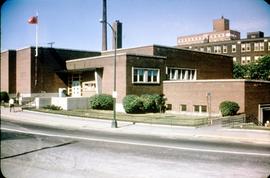
Item is a picture of the Sudbury Public Library taken from MacKenzie Street. A 'Red Ensign' flag flying.
17 yrs old - To Ann & Archie from Vic Koski - May 25/43 S.S.M.
One annotated photograph of a head and shoulders shot of Veikko (Vic) Koski.
Tweedsmuir Village History: For Home and Country Chelmsford Women's Institute Scrapbook - 2
Part of Chelmsford Women's Institute
Item consists of a scrapbook made by the Chelmsford Women's Institute. The scrapbook is divided up into the Origin of Chelmsford; The First Pioneers; St. Joseph's Church (1891 - 1950); Other Churches in the Chelmsford Community; The Presbytery & Cannon (the cannon originally protected the Church of St. Eustache in Quebec during the Papineau War and was located in the 1950's on the lawn in front of the presbytery on the corner of Main and Errington); The Presbytery(1897-1950, new rectory completed 1907) ; St. Joseph's Cemetery; The Municipality of Chelmsford (est 1890 and in 1901 separated from Balfour to become incorporated as a town. The first mayor of the Town of Chelmsford was Raphael Grouix. On January 25, 1915, council passed a motion that all future council meeting minutes be written in French. This section also includes a list of Mayors in Chelmsford from 1901 - 1956); The Chelmsford Parish Hall; The Teachers Federation Group; Hull Bridge; the Grotto of the Convent; The League of the Sacred Heart (est 1957); the Ladies of Sainte Anne (est 1906); the Children of Mary (est 1906); the Religious Order of the Grey Nuns of the Cross; History of St. Joseph's School (1889 - 1958); Ore Discoveries & the History of Nickel; Chelmsford Missionary Priests and Resident Priests (1883 - 1950); Errington Mine; Names of the men who enlisted in the Second World War from the Chelmsford Parish; Electricity in Chelmsford (est November 1947); the Water Works Project in Chelmsford (est 1948); Fire Protection (Fire Brigade est 1949); The Chelmsford Fish and Game Protective Association (est spring of 1949); Azilda (originally named Rayside by CPR but changed by Joseph Belanger to Azilda after his wife); Morgan (bought by American lumbermen George Morgan and James Craig on September 16, 1885); and Larchwood. The final section of the scrapbook is devoted to newspaper clippings concerning local news and events, including agricultural news, important visitors to the area and the activities of the Chelmsford Women's Institute along with a photograph of the members of the Chelmsford Women's Institute at their Fall Tea and Fashion Show on October 13, 1956. Tucked against the back cover of the scrapbook is a picture of Lord and Lady Tweedsmuir along with various newspaper clippings including the obituary of George Cvitkovich (ca.1907-1978), husband of Rose Cvitkovich, Convener of Historical Research for the Chelmsford Women's Institute, who compiled the scrapbooks.
Tweedsmuir Village History: For Home and Country Chelmsford Women's Institute Scrapbook - 1
Part of Chelmsford Women's Institute
Item consists of a scrapbook made by the Chelmsford Women's Institute. The scrapbook is divided up into the Lord and Lady Tweedsmuir 'forward;' a table of contents; the Origin of Chelmsford; Description of Route from Sudbury to Chelmsford; The First Pioneers; Missionary & Parish Priests (1883 - 1956); The St. Joseph's Catholic Church, Chelmsford (1891 - 1950); The Eucharistic Congress on August 31, 1947; Other Churches in the Community; The Presbytery - Rectory (1897 - 1950); St. Joseph's Cemetery; Municipality of Chelmsford, which includes a list of the Mayors from 1901 - 1950; Parish Hall, 1935; the Hull Bridge, 1919; the Teachers Federation Group; the Grotto of Chelmsford Convent, 1942; Church Organizations: League of the Sacred Heart; the Ladies of Sainte Anne and the Children of Mary; Religious Order of the Grey Nuns of the Cross; History of St. Joseph's School (1889 - 1950); Ore Discoveries & the History of Nickel; Errington Mine, 1926; Names of the men who enlisted in the Second World War from Chelmsford Parish; Electricity in Chelmsford, 1947; the Water Works Project in Chelmsford; Fire Protection; Chelmsford Pumping Station; Chelmsford Fish & Game Protective Association; Azilda; Morgan; Larchwood; Scenery from Sudbury to Murray Mine Shaft; Chelmsford Women's Institute History & Minutes, 1949 - 1950; Papers presented at the Chelmsford Women's Institute Monthly Meetings (including Pasteurizing and How it Was Discovered by Mrs. Niemi, October 5, 1949, Newfoundland by Mrs. A. DeFinney November 2, 1949, Food and Nutrition by Mrs. D. Trottier, January 11, 1950, and Resolutions by Mrs. Kallio, February 9, 1950); the Hon. Welland S. Gemmell, Sudbury M.P.P. and Provincial Mines Minister, J. Leo Gauthier, Member of Parliament, 'Give & Get Praise at Chelmsford Meeting' (Gemmell was congratulated for his recent appointment as Mines Minister) ; City of Sudbury and District Chamber of Commerce Booklet presented in the House of Commons Draws Tribute (Gauthier grateful the Trans-Canada Highway will go through Sudbury for tourist funds as well as a defense measure for the country); Post Office Explained (new post office at Verner, Sudbury Star now to be delivered in Chelmsford by truck service instead of bus service and trains); the Bank of Nova Scotia in Chelmsford (opened June 1950); and Rene Delorme, 13, of Azilda who won a $400 scholarship and a $25 cash reward through the provincial French competition in Ottawa for literature, spelling, speech and reading. The majority of the histories are accompanied by photographs and newspaper clippings. The final section of the scrapbook is devoted to newspaper clippings concerning local news and events, including agricultural news, important visitors to the area and the activities of the Chelmsford Women's Institute. Eleven copies of photographs of various priests and church scenes (all of these copies of photographs are also located inside the other scrapbook complete with captions) and eight newspaper clippings are tucked into the back of the scrapbook.
Part of Chelmsford Women's Institute
Series consists of nine papers (including drafts) written by members of the Chelmsford Women's Institute and presented at their general monthly meetings.
Town of Chelmsford & Women's Institute History
Part of Chelmsford Women's Institute
Series consists of two scrapbooks.
Fonds consists of two scrapbooks created by the Chelmsford Women's Institute and nine papers written by various members of the group.
Chelmsford Women's Institute
Chelmsford Growth and Development
Part of Chelmsford Women's Institute
Item consists of a typewritten, annotated paper, written in the format of a speech, which was most likely presented to the group at one of their monthly meetings. The paper outlines the growth and development of Chelmsford, Ontario during that time period (1950's) and focuses on such events as the laying of new roads, the creation of a new sewage system, the opening of new subdivisions, improvements to the local churches and the work being done by local groups and sports teams, such as the Lion's Club, the Women's Institute, the Girl Guides and the high school hockey team.
Chelmsford Growth and Development
Part of Chelmsford Women's Institute
File consists of papers regarding the growth and development of Chelmsford, Ontario presented during the regular monthly meetings of the Chelmsford Women's Institute.
Part of Chelmsford Women's Institute
File consists of papers regarding the history of telephones in Chelmsford, Ontario presented during the regular monthly meetings of the Chelmsford Women's Institute.
Part of Chelmsford Women's Institute
Item is a one page, typewritten paper by Rose Cvitkovich on the history of the telephone in Chelmsford, Ontario from the early 1900's to 1955.
School History of Our Community
Part of Chelmsford Women's Institute
Item is a two page, annotated, typewritten, draft paper by Rose Cvitkovich regarding the history of the schools in Chelmsford, Ontario.
The School History of Our Community
Part of Chelmsford Women's Institute
Item is a two page, annotated, typewritten draft paper by Rose Cvitkovich regarding the history of the schools in Chelmsford, Ontario.
Part of Chelmsford Women's Institute
Item is an annotated, handwritten carbon copy of a four page paper by Rose Cvitkovich regarding the history of the schools in Chelmsford, Ontario.
Part of Chelmsford Women's Institute
File consists of papers regarding the history of schools in Chelmsford, Ontario presented during the regular monthly meetings of the Chelmsford Women's Institute.
The First Pioneers & The History of Chelmsford
Part of Chelmsford Women's Institute
Item is a five page, typewritten paper by Rose Cvitkovich on the history of Chelmsford, Ontario between 1882 and 1952. The paper covers the first settlers in Chelmsford, the history of the Catholic Church in that parish as well as the history of two short-lived Protestant churches and touches on prominent individuals within the community, such as Raphael Groulx, the first mayor; Elzear Belanger, the first merchant and post master; Hugh Gratton, post master; and Dr. Rodolphe Tanguay, general practitioner. Prominent women mentioned within the essay include church decorators Mrs. D. Seguin, Mrs. Raphael Groulx and Mrs. Clement Methe.
The First Pioneers and The History of Chelmsford
Part of Chelmsford Women's Institute
Item is a six page, typewritten, annotated paper by Rose Cvitkovich on the history of Chelmsford, Ontario between 1882 and 1952. Two handwritten edits to the text can be found on page five. The paper covers the first settlers in Chelmsford, the history of the Catholic Church in that parish as well as the history of two short-lived Protestant churches and touches on prominent individuals within the community, such as Raphael Groulx, the first mayor; Elzear Belanger, the first merchant and post master; Hugh Gratton, post master; and Dr. Rodolphe Tanguay, general practitioner. Prominent women mentioned within the essay include church decorators Mrs. D. Seguin, Mrs. Raphael Groulx and Mrs. Clement Methe.
Chelmsford Pioneers and Churches
Part of Chelmsford Women's Institute
File consists of papers regarding the first settlers and churches of Chelmsford, Ontario presented during the regular monthly meetings of the Chelmsford Women's Institute.
Part of Chelmsford Women's Institute
File consists of papers regarding the history of Azilda, Ontario presented during the regular monthly meetings of the Chelmsford Women's Institute.
Part of Chelmsford Women's Institute
Item is a four page paper, handwritten in pencil on lined linen paper, regarding the African Violet. This paper describes where the flower grows naturally and how to grow and care for the flower as a house plant.
Part of Chelmsford Women's Institute
File consists of papers regarding plants or flowers presented during the regular monthly meetings of the Chelmsford Women's Institute.
Part of Chelmsford Women's Institute
File consists of two Tweedsmuir Village History scrapbooks which cover the history of Chelmsford, Ontario.
Letter from Thomas Dixon, Clerk Peace Co Bruce
Part of Charles Bibby
Item is a typed, carbon copy letter on onion skin paper from Thomas Dixon, Clerk of the Peace in Bruce County. The letter was most likely originally sent to a Canadian Pacific Railway (CPR) office in Bruce County and then copied and forwarded to other CPR stations, including the North Bay office. The letter quotes a letter Thomas Dixon received from the Attorney General on May 18, 1905 concerning homeless men in regards to burglaries and violent crimes. The letter instructs railway employees to assist the Railway Constables with handling these matters and to remind the constables of their duty to "administer the law strictly and vigorously."
Fonds consists of a typed, carbon copy letter on onion skin paper.
Bibby, Charles
Ramsey Lake - Jack Heit took photograph
Part of Heit Family
One annotated photograph of a crowd of over forty people gathered on a dock at Lake Ramsey in Bell Park. An individual can be seen diving off a diving board, as three boys stand on the diving board and watch.
This fonds consists of one scrapbook created by the 1st Coniston Wolf Cub Pack, containing information on Wolf Cub Pack meetings, a photograph of the first 1st Coniston Wolf Cub Pack and individual photographs of cub masters.
1st Coniston Wolf Cub Pack
Falconbridge Hockey Club - Nickel Belt League Champions 1932
Part of Eva Cram
Item is a composite photograph of the 1932 Nickel Belt League champions from the Falconbridge Hockey Club in Falconbridge, Ontario. Players on the team were W. Roberts, centre; W. Roque, defense; S. Delabbio, goal; G.M. Fife, defense; W. Boyce, left-wing; Max. Bennett, right-wing; L. Tulloch, defense (Captain); H. Blake, left-wing; L. Lafrance, right-wing; G. Henderson, defense; E. Beatty, goal; R. Olivier, right-wing, and J. Wolotka [J. Wolotko], centre. The composite was produced by Couture Photo - Sudbury in Sudbury, Ontario.
Falconbridge Lacrosse Club - Nickel Belt League Champions 1932
Part of Eva Cram
Item is a composite photograph of the 1932 Nickel Belt League champions from the Falconbridge Lacrosse Club in Falconbridge, Ontario. Included in the composite are G. Arnold, Secretary-Treasurer; W. Craig, Manager and J. Dickson, executive. Players are F.J. Saunders, coach; G. Henderson, centre; L.A. Blake, left attack; E. Devine, defense; V. McAllister, left attack; L. Lafrance, defense; G. Fife, defense; E. Beattie, goal; L. Tullock, defense; S. Delabbio, goal; J.F. Stacey, defense; R.V. Olivier, defense; D. Blake, right attack; Max Bennett, right attack; W. Roberts, centre, and J. Walatka [J. Wolotko], rover - captain. The composite was produced by Couture Photo - Sudbury in Sudbury, Ontario.
The fonds consists of one photograph and two composite photographs of hockey players and lacrosse players in Chapleau, Ontario and Falconbridge, Ontario.
Cram, Eva (nee Wolotko)
Part of Eva Cram
Item is a photograph of Joseph Wolotko (Joe Wolotko) wearing a Chapleau hockey uniform while standing outside on the ice in skates and holding a hockey stick.
The Canadian Bank of Commerce, Sudbury Branch No. 1335
Fonds consists of one ration cheque booklet.
The Canadian Bank of Commerce, Sudbury Branch No. 1335
This fonds consists of photographs and various textual material.
Heit (family)
Part of Heit Family
One annotated photograph of a car with King George VI and Queen Elizabeth [heading to Frood Mine] during the royal visit to Canada on June 5, 1939.
Royal Car coming up Elm St. Sudbury June 5th 7:50 P.M. - Jack Heit took photograph
Part of Heit Family
One annotated photograph of a car with King George VI and Queen Elizabeth driving up Elm Street during the royal visit to Canada on June 5, 1939.
Part of Heit Family
One annotated photograph of a car with King George VI and Queen Elizabeth driving up Elm Street during the royal visit to Canada on June 5, 1939.
Part of Heit Family
File consists of photographs taken by Jack Heit of King George VI and Queen Elizabeth visiting Sudbury, Ontario.
Part of The Canadian Bank of Commerce, Sudbury Branch No. 1335
Item is a ration cheque booklet for World War II ration book 112 butter coupons. The first two cheques are missing in the 25 cheque booklet, however, the butter ration coupon account stubs remain for these cheques (the first stub has a balance forward of 0.20, however, no identifiable information is provided for the account or the account holder).
Diane Nihil [Diane Nihill], Diana Heit, Anne Bellmore, Norma Bellmore, Janet Heit
Part of Heit Family
One annotated photograph of five girls standing together at Falcona Camp, run by Falconbridge Mine. Pictured from left to right are Diane Nihill, Diana Heit, Anne Bellmore, Norma Bellmore, Janet Heit.
17. A Pouring Molten Slag at Sudbury, Ontario - Robert Brown Ltd.
Item is a picture of six rows of molten slag taken at night.
Fonds consists of one price list for O'Flynn Cash Grocery.
O'Flynn Cash Grocery
O'Flynn Cash Grocery Price List
Part of O'Flynn Cash Grocery
Item is an annotated price list printed for O'Flynn Cash Grocery by Sudbury Star Print. Inside the volume are price lists for household items and foodstuffs. Household items include brooms, soaps and powders, polishes and starches. Foodstuffs include dried and canned fruits and vegetables, meat, eggs, cereals, jams and jellies, fish, nuts, rice, pickles and soup. O'Flynn Cash Grocery also carried baking goods, such as flour, spices, syrups, salt, yeast, sugars, lard and butter. Items such as coffee, tea, chocolate and candy could also be purchased. Written on the inside front cover is a short note from the O'Flynn Cash Grocery expounding on the benefits of paying cash for groceries versus paying with credit. The store appeals to the "old-fashioned people" in the area to buy their fresh goods with cash and save money. On the back cover of the booklet are instructions on how to order from the store. According to the price list, no shipment was too great or too small, orders just had to be plainly written on only one side of a sheet of paper and cash had to be sent with the order. The front and inside covers are designed with a swastika in each corner, a symbol used for good luck in many cultures and religions.
C.Y.O. Bulletin Volume IV, Issue 3
Item is volume IV, issue III of The Catholic Youth Organization's Bulletin.
C.Y.O. Bulletin Volume IV, Issue 2
Item is volume IV, issue II of The Catholic Youth Organization's Bulletin.
C.Y.O. Bulletin Volume IV, Issue 1
Item is volume IV, issue I of The Catholic Youth Organization's Bulletin.
C.Y.O. Bulletin Volume III, Issue 10
Item is volume III, issue X of The Catholic Youth Organization's Bulletin.
C.Y.O. Bulletin Volume III, Issue 9
Item is volume III, issue IX of The Catholic Youth Organization's Bulletin.
C.Y.O. Bulletin Volume III, Issue 7
Item is volume III, issue VII of The Catholic Youth Organization's Bulletin.
C.Y.O. Bulletin Volume III, Issue 6
Item is volume III, issue VI of The Catholic Youth Organization's Bulletin.
C.Y.O. Bulletin Volume III, Issue 5
Item is volume III, issue V of The Catholic Youth Organization's Bulletin.
C.Y.O. Bulletin Volume III, Issue 4
Item is volume III, issue IV of The Catholic Youth Organization's Bulletin.
C.Y.O. Bulletin Volume III, Issue 3
Item is of volume III, issue III of The Catholic Youth Organization's Bulletin.
C.Y.O. Bulletin Volume III, Issue 2
Item is volume III, issue II of The Catholic Youth Organization's Bulletin.
C.Y.O. Bulletin Volume III, Issue 1
Item is volume III, issue I of The Catholic Youth Organization's Bulletin.
C.Y.O. Bulletins Volumes III & IV
File consists of The Catholic Youth Organization's bulletins for the year 1947. Duplicates are included for volume III, issue 2 and issue 3. Volume III, issue 8 is missing along with all issues after March 30, 1947.
C.Y.O. Bulletin Volume II, Issue 9
Item is volume II, issue IX of The Catholic Youth Organization's Bulletin.
C.Y.O. Bulletin Volume II, Issue 8
Item is volume II, issue VIII of The Catholic Youth Organization's Bulletin.
C.Y.O. Bulletin Volume II, Issue 7
Item is volume II, issue VII of The Catholic Youth Organization's Bulletin.
C.Y.O. Bulletin Volume II, Issue 6
Item is volume II, issue VI of The Catholic Youth Organization's Bulletin.
C.Y.O. Bulletin Volume II, Issue 5
Item is volume II, issue V of The Catholic Youth Organization's Bulletin.
C.Y.O. Bulletin Volume I, Issue IV
Item is volume I, issue IV of The Catholic Youth Organization's Bulletin.
C.Y.O. Bulletins Volumes I & II
File consists of The Catholic Youth Organization's bulletins for the year 1946. Volume I issues 1-3 and volume II issues 1-4 are missing.
The series consists of twenty, four-page typed news bulletins. The Catholic Youth Organization (C.Y.O.) Bulletin was used to promote events being held by the C.Y.O., such as upcoming dances, parties, debates, outings and concerts. The sports section was usually the largest in the bulletin, advertising hikes, bike-hikes, baseball and hockey games, bowling tournaments, dart tournaments and skiing trips. Church events and special services, as well as births, marriages and deaths, were also reported. The bulletin featured regular articles, like 'It is Rumoured' and 'We Wonder...,' which both published blind gossip concerning members of the C.Y.O.; 'Howlers,' which included three or four jokes per week, and 'Do You Know?,' which provided random pieces of trivia. 'Over the Miles' was another featured article which reported on visitors in Garson and Falconbridge, as well as those members of the parish who were leaving town and whether their trips would be of long or short duration. The majority of the bulletins also had a 'Special Interviews' section, which posed six set questions to selected members of the C.Y.O., asking them their nickname, their ambition, their favourite saying and favourite song and their dislikes. Four or five interviews were published in each issue, giving a personal glimpse of the members of the C.Y.O. at the time. Another regular article was titled 'Helpful Heddie,' in which "Heddie" offered advice on a range of problems, such as how to make cinnamon toast to serve with hot cocoa, how to overcome shyness and Christmas decorating ideas. Each week an editorial was written by one of the members of the C.Y.O. and touched upon a popular issue, such as juvenile crime or modernization, or an event in the church, such as Lent or Christmas, and provided the writers opinions and ideas about the subject. An issue could be purchased for $0.01, or a yearly subscription could be bought for $0.50 for local subscribers and $1.00 if the bulletin was to be mailed.
St. John the Evangelist Catholic Youth Organization
The fonds contains bulletins published by the Catholic Youth Organization (C.Y.O.) of St. John the Evangelist Catholic Church in Garson, Ontario. The bulletins outline social and sporting news and events in St. John's Parish.
St. John the Evangelist Catholic Youth Organization
This scrapbook documents various activities of the Soroptimist Club of the Sudbury District from 1968 to their 25th anniversary in 1974. Included are photographs and newspaper clippings from the Soroptimist Scholarship Award Dinner on November 3rd, 1969 at which Edith McLennan, President of the Soroptimist Club of the Sudbury Nickel District, awarded four young student nurses their scholarships. Award recipients present in the photographs are: Margaret Houle, Louise Picard and Mary Hagan, all winners of the Edna L. Moore Scholarships, and Bonita Groulx, winner of the Soroptimist Award. The scrapbook also contains newspaper clippings covering other Soroptimist Club activities and general happenings in the community, including the presentation of a citizenship award to Christine Kleber, a high school student from Lively, Ontario, based on an essay she wrote explaining her commitment to her role in the community; the donation of books to the Sudbury Public Library about First Nations history in Canada, which was part of a larger project undertaken by the Eastern Canadian region of the Soroptimists to promote knowledge of First Nations culture, and a Christmas dinner held by the Soroptimist Club for 100 members of the Soutar Senior Citizens Club. The scrapbook also contains an honourary membership certificate presented to the 'Sudbury Club' by the Eastern Canada Region of the Soroptimists Federation of the Americas Inc. for increasing active members by 20% between March 31, 1969 and March 31, 1970, as well as three pages from the May-June 1971 issue of 'The American Soroptimist,' which includes a photograph of Christine Maria Kleber, as well as other young men and women from across North America who received a 1971 Youth Citizenship Award. Three greeting cards from the Soroptimist Clubs of Thunder Bay, Oshawa and District and Verdun LaSalle congratulating the Sudbury Nickel District chapter on their 25th Anniversary, as well as a handwritten note on the occasion from Nora Jean Quigley, have also been placed inside the scrapbook. Two identical brochures from the Soroptimist International Association promoting their clubs are also included.
Item is a scrapbook, created by the Soroptimist Club of the Sudbury Nickel District, to document their history from its inception on January 30, 1949 to their 25th anniversary in 1974. This scrapbook contains newspaper clippings regarding the formation of the Soroptimist Club of the Sudbury Nickel District, an invitation to the inaugural meeting along with two programs for the Soroptimist International Association Eastern Canada Region of the American Federation of Soroptimist Clubs Installation of Officers and Charter Dinner at Sudbury, Ontario, the Soroptimist Pledge, and a Soroptimist International Association pamphlet. One of the first large events held by the club was a fashion show in March 1949 and seven newspaper clippings about this activity are included. Congratulatory greeting cards and telegrams (2 Canadian Pacific Telegraphs telegrams and 1 Canadian National Telegraphs telegram) sent by Soroptimist Clubs from across Canada and the United States of America on the inception of the Sudbury Nickel District chapter are interspersed with a Canadian Pacific Telegraphs telegram and holiday greeting cards from numerous club chapters along with newspaper clippings on the one year anniversary of the Soroptimist Club of the Sudbury Nickel District. One card, from the Soroptimists Club of Montana, has an arrowhead taped to the card. Other newspaper clippings include another fashion show held in October 1951; regional meetings, the Soroptimists 19th Conference held in Timmins, Ontario in May of 1951; another fashion show in November 1953; a fishing expedition; a number of activities for senior citizens in the area, including a picnic, a Christmas party for the Perpetual Youth Club and afternoon teas, and books on First Nations history and culture being donated to the Sudbury Public Library. The Soroptimist Club of Sudbury presents 1952 Winners of "Singing Stars of Tomorrow" program, a 1951-52 typed one page President's Message, and an invitation to Miss A. Walker from the Mayor and Council of the City of Sudbury for a Civic Reception in honour of Prime Minister Louis St. Laurent on Sunday January 20, 1952 at 8:00 p.m. are also included. In addition is a 1967 Christmas card and two cards congratulating the Soroptimist's of Sudbury Nickel District on their 25th Anniversary. A program for the 25th Anniversary celebration held at Cassio's Motor Hotel on June 8, 1974, as well as eleven colour photographs and a number of newspaper clippings, also mark this event. Finally, a number of typed and handwritten notes are included in a folder in the back of the scrapbook explaining why the invitee could not make the 25th Anniversary celebrations. Notes are from: Joe Fabbro, Sudbury Mayor; L. Grace Wellwood, Past President, Soroptimist Federation of the Americas and Past International Officer; Soroptimist International of Cornwall, Ontario; Soroptimists of Port Hope, Ontario; Soroptimist Club of Barrie, Ontario, and K. Elliot, member, Soroptimist Club of the Sudbury Nickel District.
Soroptimist Club of the Sudbury Nickel District
Fonds consists of two scrapbooks which contain newspaper clippings, congratulatory greeting cards, photographs, correspondence, brochures, programs and a written history, all pertaining to the Soroptimist Club of the Sudbury Nickel District.
Soroptimist Club of the Sudbury Nickel District
Series consists of official extracts from parish registers of members of the Kantokoski/Koski family from the congregation of Alajärvi, in the diocese of Lapua, Finland and a certificate of confirmation from Sudbury, Ontario. The first church extract from the parish register confirms the dates of birth for Matti Niilo Kantokoski (March 23, 1901), his wife Anna Milja (Sept. 24,1903), and their daughter Eeva Annikki (May 8, 1924). The church record also notes the date Matti Kantokoski married his wife Anna (Nov. 24, 1923) and his date of death (May 15, 1956). The record is dated May 13, 1961 and signed by J. Laurila. The second church extract from the parish register confirms the date of birth for Eeva Annikki Kantokoski (May 8, 1924), the date she was baptized (May 19, 1924), the names of her parents (Matti Niilo Kantokoski & Anna Milja), the names of her godparents (Kustaa Kantokoski & Aino Kantokoski) and the name of the pastor who baptized her (J.H. Peltokallio). This record is dated June 13, 1973 and is signed by O.M. Tunturi. The Certificate of Confirmation was issued to Eeva Annikki Koski, indicating her confirmation at the Finnish Evangelical Lutheran Church in Sudbury, Ontario on July 23, 1939, signed by pastor [Mathew Lepisto].
Series consists of one annotated family tree of the Korpela family (including a photocopy of a handwritten family tree beginning with Adolf Henriksson Koivula; an annotated photocopy of a typewritten list of the children of Sandra Korpela; and an annotated, photocopy of a typewritten and hand-drawn family tree beginning with Santra Korpela); one annotated photocopy of an annotated typewritten list of the children and descendants of Santra Korpela, beginning with Kalle Gustaf (Charles) Korpela; one annotated photocopy of an annotated typewritten list of notes regarding the Korpela family, and a list of where descendants of the Korpela family were located at the time it was written; two annotated photocopies of page 8 of the passanger list of the vessel Athenia (November 1910); a computer printout from Ancestry.ca of the Canadian Passenger Lists, 1865-1935 entry for Sandra Korpela (on the ship Athenia arriving in Saint John, New Brunswick on November 28, 1910 with ship information attached; one photocopy of an annotated printout of a newspaper article from the Sudbury Star in 2004 entitled: Well-known Sault Star columnist succumbs to cancer Sunday, concerning Mr. Oliver Lehto; one computer printout of one scanned Sudbury Star newspaper article circa 2002 entitled: Sudbury developer unveils wetland park, and one scanned photograph concerning Korpela Park in Sudbury, Ontario.
One annotated photograph of Oskaria Koivula.
Lilja with children + grandchildren - Lake Penage Camp
One photograph of Lilja Koivula (far left) posing with her children and grandchildren on the steps of their camp at Lake Penage.
One photograph of Lilja Koivula (left) and Taimi Koivula (right).
Koivula Sisters L - Aino Kantokoski (visiting fr finland) R - Hilma Roiha - Sudbury, On
One annotated photograph of Aino Koivula Kantokoski (left) and Hilma Koivula Roiha (right) standing in front of a building.
One annotated print of a photograph of the Maki and Kantokoski families. In the front row from left to right are: Oscar Maki, Julia Maki (holding baby Lilja Maki), Eeva Annikki Kantokoski, Anna Kantokoski, and Veikko Vesa Kantokoski. In the back row are Oiva Maki, Oscar Maki, and Matti Kantokoski.
Ida Marie Koivula - Victor Lehti
One print of a black and white wedding photograph of Ida Marie Koivula and her husband Victor Lehti.
Amalia Koivula with Grandchildren
One print of a black and white photograph of Amalia Koivula with [two of her grandchildren].
Matti & Anna Kantokoski - 006352
One print of a painted photograph of Matti and Anna Kantokoski.
One annotated photograph of Leslie Karen Chisholm and Carl Richard Chisholm.
Ann and Archie Chisholm - May 5, 1943 Montreal Que - (Box 822 Malartic)
One annotated photograph of Ann and Archie Chisholm printed in the form of a postcard.
Sept 1939 - Olympia Café - Sudbury, Ont
One annotated photograph of a head and shoulders shot of Ann Koski, taken by a Photomatic machine (photo booth) at Olympia Café (owned by Ann's aunt Julia Koivula) in Sudbury, Ontario.
1940 - Ann E. Koski (daughter of Matti + Anna (Kantokoski) Koski in front of Sudbury Steam Bath
One annotated print of a black and white photograph of Ann E. Koski standing in front of Sudbury Steam Bath.